
Stop Guessing Your EAPCET 2026 Rank Follow This Proven Strategy
EAPCET 2026 is not just about completing the syllabus it’s about understanding what actually matters in the exam. Based on a detailed analysis of AP & TS EAPCET 2025 papers, most students lose marks not due to lack of knowledge, but due to poor strategy, time management, and focus on low-weightage topics. If you want a top rank, you need a data-driven approach knowing which chapters to prioritize, how to improve speed, and how to perform under real exam pressure. This page gives you exactly that, along with EAPCET-level mock tests designed to match the latest exam pattern and difficulty.
If you’re targeting a top rank in EAPCET 2026 (scheduled for May 9th–11th for TS and May 12th–15th& 18th for AP), just covering the syllabus won’t be enough. The real difference comes from knowing what to prioritize and where students typically lose marks. This analysis is based on actual 2025 papers (AP & TS) to give you a clear direction for 2026.
AP & TS EAPCET 2026 Mock Test Series
Full-Length Tests + Analysis
Full-Length Tests + Analysis
₹2000
Sale
₹600
⚡ High Demand • Limited Access
High-Level Insights: The 2025 EAPCET Blueprint
The 2025 papers for both AP and TS revealed a sophisticated balance between conceptual depth and calculation speed. While both exams follow a similar syllabus, the TS EAPCET leaned slightly more toward Moderate-to-Difficult problems in Mathematics, whereas the AP EAPCET focused on a high volume of concept-based questions in Physics and Chemistry.
Here’s what actually mattered in 2025 and what is likely to repeat in 2026. This analysis will provide students with a clear, data-driven roadmap based on the actual 2025 question papers. By understanding these trends, aspirants can optimize their preparation to hit high scores during the upcoming May 2026 exam window.
Subscribe For More Updates
Results • Counselling • Cutoff • Alerts
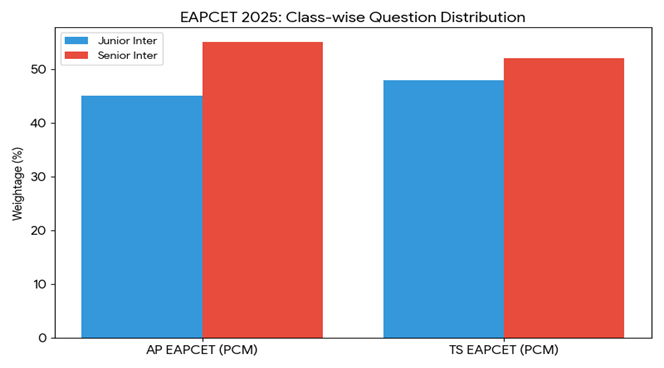
1. Class-wise Bifurcation (Junior vs Senior Inter)
A common mistake is over-focusing on Senior Inter (Class 12). In 2025, Junior Inter (Class 11) contributed approximately 45% to 50% of the questions, making it the bedrock of a good rank.
2. Difficulty Level Breakdown
Both AP and TS EAPCET papers follow a balanced pattern, with most questions falling in the easy-to-moderate range.
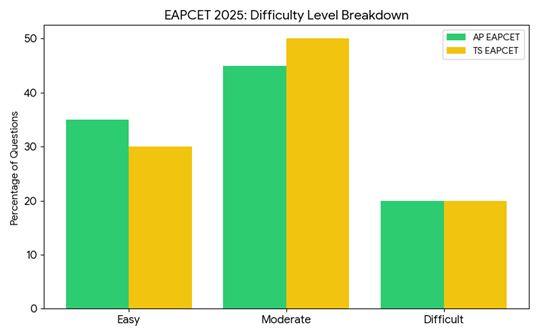
Approximately 80% of the paper falls into the Easy-to-Moderate category. The real rank difference comes from the remaining 15–20% of tougher questions, primarily in Calculus in Mathematics, Mechanics in Physics and complete Organic Chemistry in Chemistry subject.
3. Physics (40 Marks): Concept Application
Physics in 2025 was more about applying concepts quickly than doing heavy calculations. Mechanics and Electrodynamics are the twin pillars of this section.
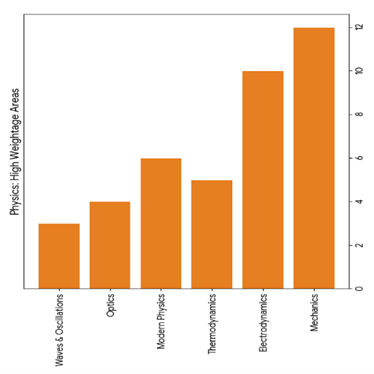
Top 5 High-Weightage Units:–
- Mechanics (12 Qs): Work-Power-Energy, Laws of Motion, and Rotational Mechanics are the “Must-Dos.”
- Electrodynamics (10 Qs): Current Electricity and Moving Charges remain high-priority.
- Modern Physics (6 Qs): High-scoring and direct questions from Atomic and Nuclear Physics.
- Thermodynamics (5 Qs): Excellent ROI for the effort required.
- Optics (4 Qs): Primarily focused on Ray Optics and Wave Interference.
4. Chemistry (40 Marks): The Scoring Powerhouse
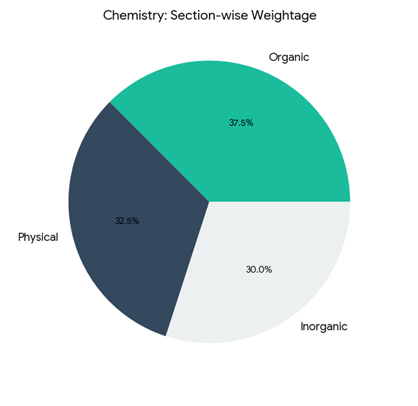
For most students, Chemistry is the section where time can be saved — if concepts are clear. The 2025 papers showed a near-even split, but Organic Chemistry had a slight edge in complexity.
Top High-Weightage Areas:
- Organic Chemistry (15 Qs): GOC, Hydrocarbons, and Alcohols/Phenols. This is the “Best ROI” section if your basics are strong.
- Physical Chemistry (13 Qs): Atomic Structure, Chemical Kinetics, and Solutions.
- Inorganic Chemistry (12 Qs): Chemical Bonding and p-Block Elements.

JEE Main Session 2 2026
Start Free Online Test Series
START PRACTICING NOW
Start Free Online Test Series
High Demand • Limited Access

5. Mathematics (80 Marks): The Rank Decider
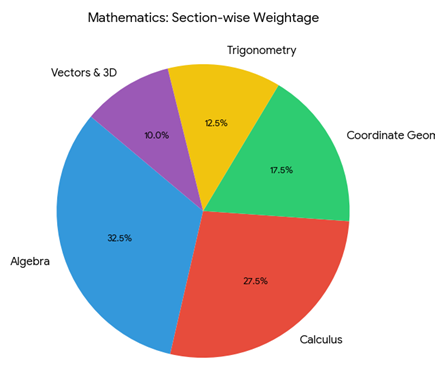
If you’re aiming for a top rank, Mathematics is non-negotiable for PCM students. The 2025 analysis shows that Algebra and Calculus together command nearly 60% of the Math section.
Top 5 High-Weightage Chapters (2025 Trends):–
- Algebra (26+ Qs): Matrices, Complex Numbers, and Quadratic Equations are the top scorers.
- Calculus (22+ Qs): Focus on Definite Integration and Differential Equations.
- Coordinate Geometry (14+ Qs): Circles and Parabolas consistently provide high-value questions.
- Trigonometry (10+ Qs): Functions and Identities are foundational for the entire Calculus section.
- Vectors & 3D Geometry (8+ Qs): These are “High-ROI” because they are relatively easier to master than Calculus.
6. Score vs Rank Expectation (EAPCET 2026)
The paper of EAPCET is out of 160 marks. Physics and Chemistry are of 40 marks each and Mathematics or Biology are of 80 marks. The ranking system is highly competitive. AP EAPCET includes 25% weightage from Intermediate (Board) marks, while TS EAPCET ranking is based entirely on entrance performance.
| Marks Obtained (Out of 160) | Expected Rank (Engineering) | Expected Rank (Agriculture/Medical) |
| 150 – 160 | 1 – 50 | 1 – 20 |
| 140 – 149 | 51 – 500 | 21 – 210 |
| 120 – 139 | 501 – 2,500 | 211 – 960 |
| 100 – 119 | 2,501 – 5,000 | 961 – 2,340 |
| 80 – 99 | 5,001 – 15,000 | 2,881 – 6,900 |
Note: Rank ranges are indicative and may vary based on difficulty level, normalization, and board weightage (in AP EAPCET).
7. Strategic Prep for PCM vs PCB Students
For PCM Candidates (Engineering Stream):–
- Focus on Math Speed: You have 160 questions in 180 minutes. Try to finish Chemistry quickly so that maximum time can be allocated to Mathematics.
- Best ROI Strategy: Prioritize Matrices, Vectors, and 3D Geometry in Math, and Modern Physics in Physics. These are easier to score than the heavy-calculus topics.
For PCB Candidates (Agriculture/Medical Stream):
- Biology Dominance: Biology carries 80 marks. Master the Genetics, Ecology, and Human Physiology units as they are high-scoring.
- Chemistry is Key: For PCB students, Chemistry is often the differentiator. Focus on Biomolecules and Polymers which bridge Biology and Chemistry.
8. Expert Analyst Tip for EAPCET 2026
Based on the TS EAPCET (May 9-11) and AP EAPCET (May 12-15 & 18) schedules, students should finish their full syllabus revision by the end of April.
If there’s one thing you should not skip: Practice Full-Length Mock Tests in the exact shift timings (Morning/Afternoon) provided in your hall ticket. This builds the mental stamina required for the 3-hour computer-based test (CBT).
Ready to Test Your Prep? Our EAPCET 2026 Mock Test Series is launching soon, specifically designed for combined AP & TS aspirants (PCM stream). These tests mirror the 2025 difficulty levels and topic distribution identified in this analysis.
Attempt EAPCET 2026 Mock Tests & Master the Trends!
EAPCET 2026 – Most Important FAQs
What is the best strategy to prepare for EAPCET 2026?
The best strategy is to focus on high-weightage topics, time management, and mock tests. Nearly 80% questions are easy to moderate, but rank depends on how you handle tough questions.
How important are mock tests for EAPCET 2026?
Mock tests are essential for success. They improve speed, accuracy, and confidence by simulating real exam pressure.
What is the expected difficulty level of EAPCET 2026?
About 75–80% questions are easy to moderate, while 15–20% are tough and decide top ranks.
Which chapters are most important for EAPCET 2026?
Math: Algebra, Calculus
Physics: Mechanics, Electrodynamics
Chemistry: Organic Chemistry
How many marks are needed for top rank in EAPCET?
150+ marks → Top 50 rank
140+ marks → Top 500 rank