
BITSAT 2026 Decoded: A Data-Driven Strategy & Chapter-Wise Analysis
Introduction: The BITSAT Advantage
The Birla Institute of Technology and Science Admission Test (BITSAT) is a well-known targeted engineering entrance examination alongside JEE for most of the aspirants. The key to success in BITSAT is not just maximizing your score but optimizing your efforts, ensuring that your core JEE preparation forms the base, with minimal extra effort to conquer the BITSAT-specific sections like, English Proficiency (EP) and Logical Reasoning (LR).
This blueprint analyses BITSAT paper trends, breaking down chapter-wise weightage to build a time-efficient strategy. It’s designed to help you convert your existing JEE knowledge into a top BITSAT score.
1. Subject-Wise Weightage Analysis (Based on Previous Years’ Trend)
The BITSAT paper features 130 questions across five sections. Here is how the subjects were distributed and their preparation focus:
| Subject | Total Questions | Class 12 Contribution | Class 11 Contribution | Core JEE Focus | BITSAT Differentiator |
| Physics | 30 | 63.3% | 36.7% | High | Low |
| Chemistry | 30 | 60.0% | 40.0% | High | Low |
| Mathematics | 40 | 59.0% | 41.0% | High | Low |
| English Proficiency | 10 | N/A | N/A | N/A | High |
| Logical Reasoning | 20 | N/A | N/A | N/A | High |
| Total | 130 |
My Exams Expert Insight: The Class 12 syllabus clearly carries a higher weightage (approx. 60%) in PCM. While Class 12 topics are the priority, maintain a consistent revision of core Class 11 concepts. English and reasoning are the major differentiators.
2. High-Yield Topics: Your ROI Checklist
To achieve a high score with optimized effort, focus on the topics that consistently yield a high number of questions. Here is the subject-wise breakdown of high yield topics.
A. Physics (Total Questions: 30)
| Top 5 High-Weightage Topics | Questions | Expert Takeaway |
| Atoms | 3 | BITSAT favours direct, theory or formula-based chapters. These are quick and high-scoring wins. |
| Wave Optics | 3 | Wave optics is a slightly more advanced topic that yields great returns. |
| Electromagnetic Waves | 2 | Crucial for JEE also, but easy questions are guaranteed in BITSAT. |
| Kinetic Theory of Gases (KTG) | 2 | A simple chapter from Class 11 for quick marks. |
| Electrostatics Potential | 2 | Core Class 12 concepts must be mastered. |
Analyzing the Class 11 Physics Pie Chart
- The Class 11 pie chart provides a very clear and strategic insight about physics. As the data shows, ‘Kinetic Theory of Gases’ (KTG) was the single most dominant chapter, accounting for 18.2% of the questions from the Class 11 syllabus. This makes KTG your highest Return on Investment (ROI) topic; it’s a relatively simple, formula-based chapter that yielded double the questions of other topics.
Beyond KTG, the story is one of balance. Major foundational units like ‘Rotational Motion’, ‘Gravitation’, ‘Oscillations (SHM)’, and ‘Thermodynamics’ each had an equal 9.1% share.
Strategic Takeaway: Your top priority should be mastering KTG. After that, do not make the mistake of favouring one major unit over another. The data shows that any of the core mechanics or thermal physics chapters are fair game. A broad, formula-level understanding of all these 9.1% topics is safer than deep-diving into just one or two.
Analyzing the Class 12 Physics Pie Chart
The Class 12 data tell a story of concentration. Unlike the balanced class 11 syllabus, here you can see clear ‘super-topics.’
The highest ROI topics, by a massive margin, are ‘Wave Optics’ and ‘Atoms.’ Each contributed 3 questions, a combined 31.6% of the class 12 pie. Mastering these two chapters is not optional; it’s the single most effective way to boost your score.
Following closely are the high-yield topics of ‘Electrostatics Potential’ and ‘Electromagnetic Waves,’ both at 10.5% (2 questions each). This means these four chapters alone accounted for more than half of all questions from the Class 12 syllabus.
Strategic Takeaway: Your BITSAT Physics strategy is clear. Focus your energy on the Modern Physics and Optics units. The data shows this is the undeniable ‘goldmine’ for marks, offering the best possible return on your study time.
B. Chemistry (Total Questions: 30)
| Top 5 High-Weightage Topics | Questions | Expert Takeaway |
| Structure of Atom | 2 | A foundational topic and a consistent high weightage in the exam. |
| Solutions | 2 | Direct application of formulas and concepts. |
| Hydrocarbons | 2 | Highly focused area in organic chemistry. |
| Electrochemistry | 2 | A crucial, calculation-intensive topic. |
| The d and f Block Elements | 1 | A quick-study inorganic topic with a high return on revision. |
Analyzing the Class 11 Chemistry Pie Chart:
The Class 11 Chemistry data show a clear split. The highest-ROI (Return on Investment) topics are undeniably ‘Structure of Atom’ and ‘Hydrocarbons,’ each contributing 16.7% (2 questions) to the class 11 portion. These two chapters alone accounted for over a third of the questions. Following them, the rest of the syllabus shows a very balanced distribution. Key chapters like ‘Chemical Bonding’, ‘Thermodynamics’, ‘Periodicity’, and even smaller chapters like Environmental Chemistry all carried an equal weight of 8.3%.
.
Strategic Takeaway: Your study plan should be clear. Prioritize ‘Structure of Atom’ and ‘Hydrocarbons’, for deep revision; they give you the best return for your time. For the rest of the syllabus, breadth is more important than depth. The data shows that BITSAT will pick one question from almost any of the remaining chapters, so a solid foundational knowledge of all of them is essential.
Analyzing the Class 12 Chemistry Pie Chart
The Class 12 Chemistry pie chart shows a story of broad, equal distribution. Unlike Physics, there are no ‘super-topics’ that wildly outweigh the others.
The highest-ROI topics are ‘Electrochemistry’ and ‘Solutions,” which were the only chapters to yield 2 questions each. At 11.1% apiece, these are the ‘‘exploded slices’ on the chart and should be your top priority for in-depth revision.
However, the real takeaway is the incredible balance of the remaining 14 topics, each contributing a single question (5.6% of the pie). This includes the entire Organic Chemistry lineup ‘Haloalkanes’, ‘Alcohols’, ‘Aldehydes’, ‘Amines’, as well as key chapters like ‘Coordination Compounds’, ‘d/f Block’, and ‘Biomolecules’.
Strategic Takeaway: You cannot “cherry-pick’ your way through Class 12 Chemistry. The data proves that BITSAT tests a wide-breadth of knowledge. Your best strategy is to ensure a solid, foundational understanding of all these topics, with a special emphasis on mastering the calculation-based chapters: ‘Electrochemistry” and ‘Solutions’.
C. Mathematics (Total Questions: 40)
| Top 5 High-Weightage Topics | Questions | Expert Takeaway |
| Probability | 4 | This section holds the highest weightage in the entire paper, so it is important to dedicate extra time here. |
| Three–Dimensional Geometry | 3 | Vectors and 3D geometry are often combined and form a high-yield block. |
| Application of Derivatives (AOD) | 3 | It’s a major calculus topic with a wide range of applications. |
| Area Under Curve and LPP | 2 | Linear Programming Problem (LPP) is a BITSAT-specific scoring topic; do not skip it. |
| Quadratic Equations and Inequalities | 2 | Fundamental algebra that impacts many other chapters. |
Analyzing the Class 11 Mathematics Pie Chart
The Class 11 Mathematics data reveal a clear group of high-ROI topics. Unlike the other subjects, there’s a distinct top tier. The three chapters that stand out are ‘Quadratic Equations and Inequalities,’ ‘Complex Number,” and ‘Set,’ each contributing 2 questions. Together, these three chapters alone (at 11.8% each) make up a full one-third (35.4%) of all questions from the class 11 syllabus, making them the most valuable use of your study time.
The rest of the pie is filled with a wide, balanced spread of foundational topics. Twelve other chapters, including Trigonometry, Permutations & Combinations, Binomial Theorem, and the Conic Sections Straight Lines, Circle, Parabola, Hyperbola, contributed equally (5.9% each).
Strategic Takeaway: Your strategy must be twofold. First, gain absolute mastery over the high-ROI trio: Quadratic Equations, Complex Numbers, and Sets. These are your most reliable source of marks. Second, for the remaining 12 topics, a broad understanding of formulas and problem-types is essential, as the data shows BITSAT will test your breadth of knowledge.
Analyzing the Class 12 Mathematics Pie Chart
This is the most important chart of all, and the data is exceptionally clear. Class 12 Mathematics is a game of ‘super-topics,’’ and mastering them is the fastest path to a high score.
The undisputed king is ‘Probability,’ standing alone with 4 questions. At 17.4%, this one chapter is the single highest ROI topic in the entire BITSAT exam.
Following this are two more heavy-hitters: ‘Application of Derivatives’ (AOD) and ‘Three-Dimensional Geometry,’ each with 3 questions (13.0% apiece). This ‘Big 3’ (Probability, AOD, 3D Geometry) accounts for 10 questions in total. That’s 43.4% of the Class 12 pie a massive concentration of marks from just three units.
The next tier includes Calculus and Area Under Curve, and LPP, with 2 questions each.
Strategic Takeaway: Your study plan for Maths is simple. First, master the ‘Big 3’: Probability, AOD, and 3D Geometry. They are your goldmine. Second, secure the medium-weightage topics from Calculus (Functions, Differentiation, Integration). The data proves that focusing your efforts on these 5-6 “super-topics” will yield a massive return and is the most strategic way to conquer the Maths section.
3. The X-Factor: English Proficiency & Logical Reasoning (EP & LR)
These two sections are the big differentiators from the JEE syllabus. Mastering them is the fastest way to gain an edge.
| Subject | Total Questions | Prep & Revision Hours (Total) | Key High-Yield Areas |
| English Proficiency_EP | 10 | 40 Hours | Synonyms, antonyms, para-jumbles, inferential questions (interpretation). |
| Logical Reasoning_LR | 20 | 60 Hours | Number analogy, coding-decoding, missing term in figure. |
- Smart Strategy: Dedicate minimal, focused time to these two sections (just 100 hours total for both EP & LR). For LR, practice is key; focus on pattern recognition. For EP, a basic grasp of grammar rules and vocabulary builders (synonyms/antonyms) is sufficient. This is the highest Return on Investment (ROI) section of the exam.
Analyzing the English Proficiency (EP) Chart
The English Proficiency data is all about concentration. The section is dominated by four key areas, each contributing 2 questions: Synonyms, Antonyms, Para-jumbles, and Inferential Questions. These four topics alone account for 80% of the entire EP section.
Strategic Takeaway: Your study plan is incredibly focused. The highest Return on Investment (ROI) comes from mastering these four “super-topics.” While other grammar rules like conjunctions are useful, your primary effort should be on vocabulary (Synonyms / Antonyms) and comprehension / logic (Para-jumbles / Interpretation) to secure the vast majority of marks.
Analysing the Logical Reasoning (LR) Char
The Logical Reasoning section is a mix of high-value topics and a very broad base. The clear highest-ROI (Return on Investment) topic is ‘Number Analogy,’ which stands alone with 3 questions.
Following this is a strong second tier of topics that yielded 2 questions each: ‘Alphabet test,’ ‘Coding-decoding,’ and ‘Missing term in figure.’ These top four topics alone make up 45% of the entire LR section.
Strategic Takeaway: Your study plan should be clear. Master the top four, with a special focus on ‘Number Analogy.’ After that, the data shows a long tail of 11 different topics, each with one question. This means a broad, quick familiarity with all problem types is essential to capture the remaining marks.
4. Expert Strategy for Smart Study & Revision
If you are already a JEE aspirant, then BITSAT strategy must be an add-on to your preparation, not a complete overhaul. The following time distribution suggests the minimum focus required for the BITSAT exam based on our analysis:
| Subject | Prep Hours | Revision Hours | Total Focused BITSAT Effort |
| Physics | 310 | 150 | 460 hours |
| Chemistry | 214 | 95 | 309 hours |
| Mathematics | 216 | 120 | 336 hours |
| EP & LR | 90 | 45 | 100 hours |
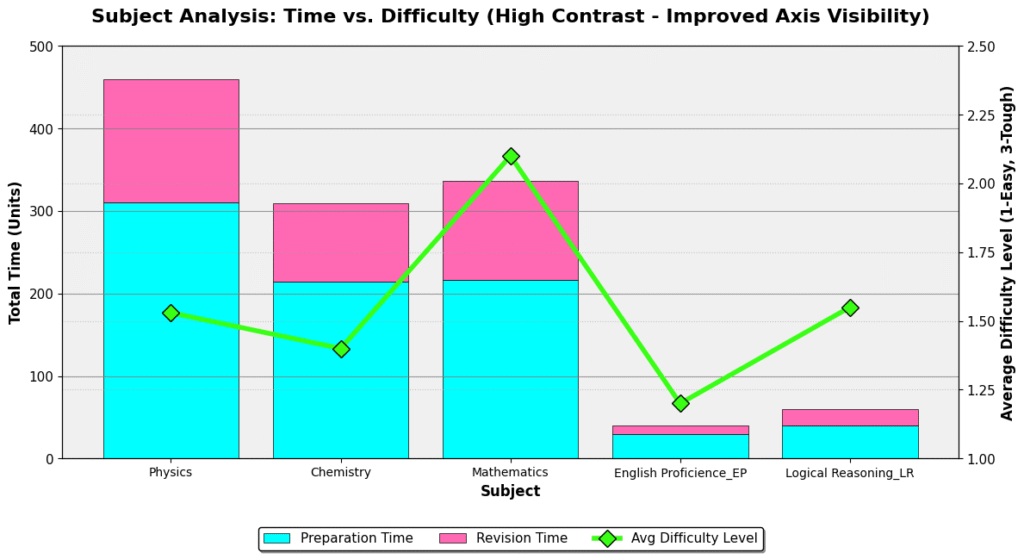
The above-mentioned graph analyses five subjects; Physics, Chemistry, Mathematics, English & Logical Reasoning, comparing the total time investment (preparation and revision) against their perceived difficulty.
Physics requires the largest overall time commitment (460 units), significantly more than any other subject, though it has only a moderate difficulty level (1.53).
Chemistry falls in the middle, demanding a substantial 309 units of time but being rated as relatively easy (1.4).
A clear correlation between difficulty and time is visible with Mathematics, which is rated as the most difficult subject (2.1) and correspondingly requires the second-highest time investment (336 units).
Conversely, English Proficiency and Logical Reasoning are clear outliers, requiring minimal time (40 and 60 units, respectively) and ranking as the two easiest subjects.
In summary, the core subjects (Physics, Maths, Chemistry) demand the vast majority of time, with Mathematics standing out as the most challenging.
Key Actionable Advice:
- Integrate PCMB: This data confirms that BITSAT preparation is an add-on, not an overhaul. Your core JEE syllabus study covers the majority of the work.
- Daily EP & LR Slot: Allocate a small, dedicated daily slot (e.g., 30-45 minutes) exclusively to EP and LR. Given the total of 100 hours, this is highly manageable and non-disruptive to your JEE schedule.
- Prioritize High-Weightage: Use the high-weightage topic list to allocate extra time in your weekly revision. For instance, dedicate a revision slot to Probability and Wave Optics every week.
- Mock Tests are Mandatory: BITSAT is a speed test. Mastering its time-per-question pressure is impossible without regular, full-length mock tests. This is more crucial for BITSAT than for any other exam.
- Do Not Ignore Zero-Question Topics: A quick formula review of these chapters (like Vector, Fluid Mechanics, etc.) will ensure you capitalize on any easy questions that might be included in your specific paper shift.
Conclusion: From Blueprint to Victory
1. How is BITSAT preparation different from JEE Main preparation ?
Ans: JEE and BITSAT share the same PCM topics, but the exam style is totally different. BITSAT isn’t just about deep concepts; it is a race against the clock. The real game-changer here is the English Proficiency (EP) and Logical Reasoning (LR) section. You don’t need to restart your preparation from scratch. Just use your JEE knowledge as a base, add specific practice for speed, and spend some targeted time on the extra sections like EP & LR.
2. Which chapters have the highest weightage in BITSAT 2026 ?
Ans: Based on data trends shared in the blog, certain ‘super-topics’ yield the highest return on investment. like in Mathematics, Probability is the undisputed king with the highest weightage, followed by 3D Geometry and Application of Derivatives. In Physics, modern topics like Atoms and Wave Optics are crucial. For Chemistry, Electrochemistry and Solutions are the top high-yield chapters. Mastering these specific units is the fastest way to boost your score.
3. Is Class 12 syllabus more important than Class 11 for BITSAT ?
Ans: Yes, the data shared above indicates a clear tilt towards the Class 12 syllabus, which contributes approximately 60% of the questions in Physics, Chemistry, and Mathematics. However, you cannot ignore Class 11 entirely. Specific Class 11 chapters like Kinetic Theory of Gases (Physics) and Quadratic Equations (Math) are identified as high-ROI topics that offer easy marks. A balanced approach prioritizing Class 12 depth and Class 11 breadth is recommended.
4. How much time should I dedicate to English Proficiency and Logical Reasoning ?
Ans: You do not need to spend months on these sections. Our analysis suggests a focused investment of roughly 100 hours total (40 hours’ for English Proficiency and 60 hours for Logical Reasoning) is sufficient. A smart strategy involves setting aside a small, daily slot of 30-45 minutes. Focus on high-yield areas like Number Analogy in Reasoning and Synonyms or Antonyms, in English to maximize your output with minimal effort.
5. Why is Mathematics considered the toughest section in BITSAT ?
Ans: Our comparative analysis rates Mathematics with the highest difficulty level (2.1) and it requires the second-highest time investment after Physics. The section often combines concepts, such as Vectors with 3D Geometry. To tackle this, the strategy shouldn’t be to solve every hard problem, but to master the “Big 3’’ topics (Probability, AOD, 3D Geometry), which alone account for over 40% of the Class 12 portion, ensuring you secure the bulk of the marks.
6. What is the best way to utilize the ‘‘High-Yield Topics” list for revision ?
Ans: Use the High-Yield list to prioritize your revision schedule. Instead of revising sequentially chapter-by-chapter, focus your energy on the ‘Goldmine” topics first. For example, ensure you are practicing calculation-based questions for Electrochemistry and reviewing formulas for Wave Optics weekly. As mentioned in our conclusion, combining this targeted revision with a comprehensive test series, like the one on the MyExams.Ai app, helps build the necessary exam-day muscle memory.
We’ve successfully decoded the BITSAT blueprint, giving you a clear strategic map of the high-ROI topics. But knowing the map is only half the battle. The real victory comes from using it. BITSAT is a game of speed, accuracy, and applying this knowledge under intense pressure. This is where your practice must transition from theory to reality.
Mastering this data-driven strategy isn’t just about solving questions; it’s about building “exam-day’’ muscle memory. The final, critical piece of the puzzle is to relentlessly simulate this environment. Finding a comprehensive test series platform, one with an interface built to mirror the BITSAT exam’s unique pattern—like the one on the MyExams.Ai app is the logical next step to ensure your hard work translates into a top score.