
JEE Advanced Preparation Blueprint: A Smart Study Plan & Revision Strategy

5 Years of Detailed Analysis: Subject-wise, Class-wise, and Topic-wise insights to maximize Your ROI
Introduction
Clearing JEE Advanced – gateway to India’s prestigious IITs – requires not just intelligence, but strategy. Unlike JEE Main, this exam isn’t about solving formula-based questions; it tests your ability to integrate concepts, reason logically, and manage time under extreme pressure. With unpredictable paper patterns, success depends on smart, data-driven preparation – not guesswork.
This comprehensive analysis, curated by the experts at MyExams.AI, delves into the actual JEE Advanced papers from 2021–2025 to reveal:
- Exactly how many questions are asked from each subject and chapter.
- The Class 11 vs Class 12 syllabus contribution and topic-wise ROI.
- Strategic preparation and revision plans based on real data.
Our deep dive shows clear patterns. For instance, Mathematics is consistently the most time-consuming with its lengthy calculations. Physics demands deep conceptual clarity, while Chemistry often acts as the balancing subject, mixing scoring opportunities with tricky concepts.
MyExams.AI Tip: Instead of trying to master everything equally, focus on high-yield chapters that give the maximum return for your effort. Build strong fundamentals, revise regularly, and practice past-year papers in timed conditions. With a strategic approach, even the toughest exam becomes manageable.
Section 1: The Big Picture: Overall Coverage – Class & Subject-wise Analysis
Before we dive into chapter-wise details, let’s first look at the overall exam structure and its competency level. Understanding this big-picture structure is the first step in building a strong preparation strategy.
Insight 1: The Myth of a “Favorite” Subject
Do the IITs favor one subject over another? The 5-year data make it clear that the balance is key. All three subjects carry nearly identical weight, and each deserves equal focusing your preparation.
| Subject | Class 11 | Class 12 | Total Ques. (2021-2025) | Overall Weightage |
| Physics | 87 | 89 | 176 | 33.6% |
| Chemistry | 59 | 113 | 172 | 32.8% |
| Mathematics | 68 | 108 | 176 | 33.6% |
| Grand Total | 214 | 310 | 524 | 100% |
Note:
- Equal weightage is given to Physics, Chemistry & Mathematics; the pattern is identical across subjects.
- The total number of questions is not fixed and may vary each year.
- Minor variations arise when certain questions are dropped by IITs post-exam.
The Takeaway
The graph shows almost equal weightage across Physics, Chemistry, and Mathematics. Chemistry leans slightly toward Class 12, while Physics and Mathematics are evenly split. The message is clear: you cannot afford to ignore any subject or class. Yearly variations happen, but the overall balance remains consistent.
Insight 2: The Class 11 vs Class 12 Dynamic
Overall, JEE Advanced leans toward Class 12, which contributes about 59% of the questions. But when we check subject-wise, the picture shifts.
| Subject | Questions asked Class 11 | Questions asked Class 12 | Total Questions Asked (2021-2025) |
| Physics | 87 (49%) | 89 (51%) | 176 |
| Chemistry | 59 (35%) | 113 (65%) | 172 |
| Mathematics | 68 (39%) | 108 (61%) | 176 |
| Grand Total | 214 (41%) | 310 (59%) | 524 |
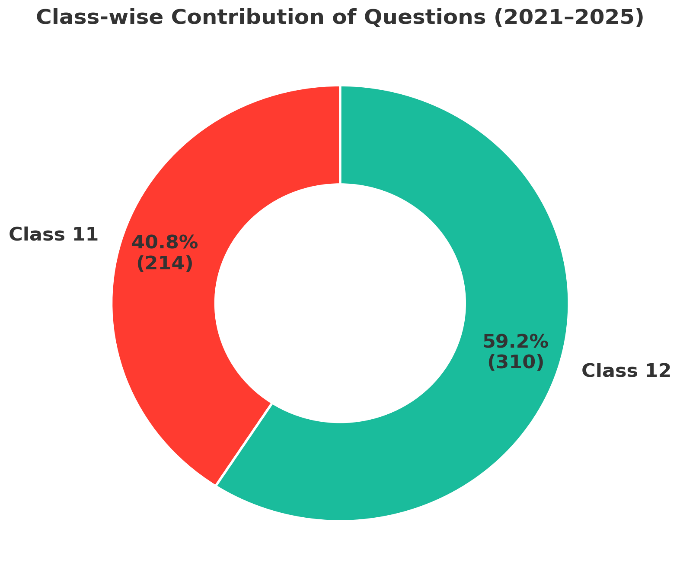
Key Strategic Insights
The data shows Class 12 dominates especially in Chemistry and Mathematics, where nearly two-thirds of questions come from the final-year syllabus. Physics is the exception, with both classes contributing almost equally. Still, Class 11 forms over 40% of the paper, making it impossible to ignore. The smart approach is to strengthen Class 12 while reinforcing key Class 11 fundamentals.
Insight 3: From Data to Discipline – Your Time Allocation Blueprint
Knowing what to study is only half the challenge; the other half is managing your time wisely. This breakdown shows the time demands of Physics, Chemistry, and Mathematics, helping you plan a realistic weekly routine.
| Subject | Prep Time (in Hrs) | Revision Time in (Hrs) | Grand Total (in Hrs) | Your Weekly Goal(Approximate) |
| Chemistry | 422 | 243 | 665 | 13.3 hours/week |
| Mathematics | 462 | 159 | 621 | 12.5 hours/week |
| Physics | 339 | 121 | 460 | 9.2 hours/week |
| Total | 1223 | 523 | 1746 | 35 hours/week |
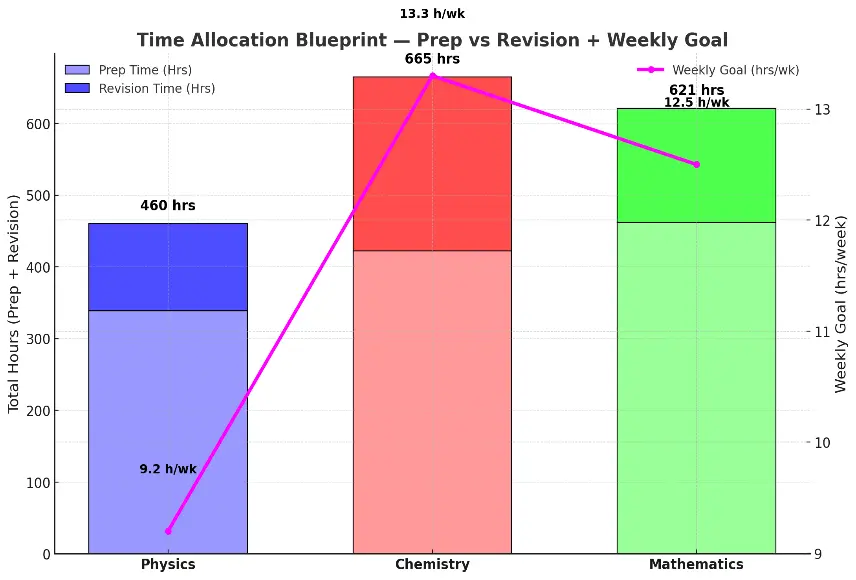
The Takeaway
The data highlights Chemistry as the most time-intensive subject, mainly due to its heavy 243-hour revision load. This confirms its nature – mastery requires relentless, spaced repetition.
Conversely, Mathematics demands the most ‘Preparation Time’ (462 hours), building a strong problem-solving base.
Physics is more balanced, sticking well once concepts are clear.
Together this translates into a balanced study plan equals approx. 35 hrs/week – the data-backed path to full coverage and mastery. If we classified it subject-wise then Chemistry approx. 13 hrs, Mathematics approx. 12.5 hrs, and Physics approx. 9 hrs. This balance of prep and revision creates a disciplined routine that boosts retention and exam readiness.
With the overall weekly blueprint in place, it’s time to dive deeper – looking at each subject individually. We will break down Physics, Chemistry, and Mathematics chapter-wise, mapping their weightage, the preparation hours they demand, and the revision cycles required.
Let’s breakdown each subject so you know exactly where to focus your next study session.
Section 2: The Complete Blueprint for JEE Advanced – ‘Physics’
Physics is often the rank-deciding subject in JEE Advanced. It demands strong conceptual clarity, but with the right and smart strategy it can become a scoring edge.
Over the last five years, Physics has been almost evenly split – around 49% from Class 11 and 51% from Class 12. This balance makes it essential to give equal attention to fundamentals and advanced topics. The table below maps each chapter, its average weightage, and the time recommended for preparation and revision, helping you structure a focused and realistic study plan.
After this, we’ll also highlight the High-ROI topics the ones that give maximum return for the hours you invest.
1. Chapter-wise Physics Blueprint (2021–2025)
This table covers every Physics topic, its average weightage across five years, and the prep/revision time required. Use it to structure your year-long study with both fundamentals and advanced topics in mind.
Topic | Class | TotalQuestions(5Yrs) | Avg.Questions(5Yrs) | PreparationTime (in hrs) | RevisionTime (in hrs) |
| 01. Unit and Dimensions | 11 | 9 | 1.8 | 10 | 3 |
| 02. Kinematics | 11 | 0 | 0 | 10 | 5 |
| 03. Projectile, Vectors, Relative Motion | 11 | 5 | 1 | 20 | 5 |
| 04. Newton’s Laws of Motion and Friction | 11 | 2 | 0.4 | 15 | 5 |
| 05. Work, Energy and Power, Circular Motion | 11 | 2 | 0.4 | 15 | 7 |
| 06. Center of Mass, Rotational Motion | 11 | 17 | 3.4 | 30 | 10 |
| 07. Oscillations | 11 | 5 | 1 | 15 | 7 |
| 08. String Wave, Sound Wave | 11 | 9 | 1.8 | 15 | 6 |
| 09. Fluid Mechanics, Surface Tension and Viscosity, Elasticity | 11 | 10 | 2 | 25 | 10 |
| 10. Gravitation | 11 | 6 | 1.2 | 11 | 5 |
| 11. Calorimetry and Heat Transfer, Thermal Expansion | 11 | 7 | 1.4 | 20 | 7 |
| 12. Kinetic Theory of Gases Thermodynamics | 11 | 15 | 3 | 20 | 7 |
| 13. Current Electricity | 12 | 4 | 0.8 | 15 | 5 |
| 14. Electrostatics | 12 | 15 | 3 | 15 | 5 |
| 15. Capacitance | 12 | 5 | 1 | 12 | 4 |
| 16. Magnetic Effect of Current | 12 | 13 | 2.6 | 15 | 5 |
| 17. Electromagnetic Induction | 12 | 5 | 1 | 15 | 5 |
| 18. Alternating Current | 12 | 5 | 1 | 10 | 4 |
| 19. Electromagnetic Waves | 12 | 1 | 0.2 | 5 | 2 |
| 20. Geometrical Optics | 12 | 17 | 3.4 | 20 | 8 |
| 21. Wave Optics | 12 | 7 | 1.4 | 8 | 3 |
| 22. Modern Physics | 12 | 10 | 2 | 10 | 4 |
| 23. Nuclear Physics | 12 | 7 | 1.4 | 8 | 3 |
| Total | 176 |
2. The High-ROI Hit List: Maximum Marks in Minimum Time
While the chapter-wise blueprint is for comprehensive coverage, this section is for strategic advantage. We’ve calculated a “Return on Investment” (ROI) score for each topic by comparing its question weightage to the time it takes to prepare.
These high-ROI topics take relatively less time to prepare but frequently appear in the exam. Starting with them helps secure early marks and confidence.
Top 5 High-ROI Topics: Class 11
| Topic/Chapter | Avg. Questions | Total Time (Hrs) | ROI Score |
| Unit and Dimensions | 1.8 | 13 | 0.138 |
| Fluid Mechanics & Properties of Matter | 2.0 | 23 | 0.087 |
| String Wave, Sound Wave | 1.8 | 23 | 0.078 |
| Gravitation | 1.0 | 15 | 0.067 |
| Thermodynamics & KTG | 1.8 | 30 | 0.060 |
Top 5 High-ROI Topics: Class 12
| Topic/Chapter | Avg. Questions | Total Time (Hrs) | ROI Score |
| Alternating Current | 1.2 | 15 | 0.080 |
| Modern Physics & Nuclear Physics | 2.4 | 35 | 0.069 |
| Ray Optics | 2.6 | 40 | 0.065 |
| Magnetic Field | 2.4 | 30 | 0.080 |
| Electromagnetic Induction | 1.8 | 22 | 0.082 |
3. How to Use These Tables: A Strategic Approach
Begin with high-ROI topics like Unit and Dimensions, Fluid Mechanics, and Modern Physics to get quick returns. Then gradually work through high-weightage chapters such as Rotational Motion and Electrostatics, which require more time but are crucial for top ranks. Balance prep with consistent revision, especially for error-prone chapters.
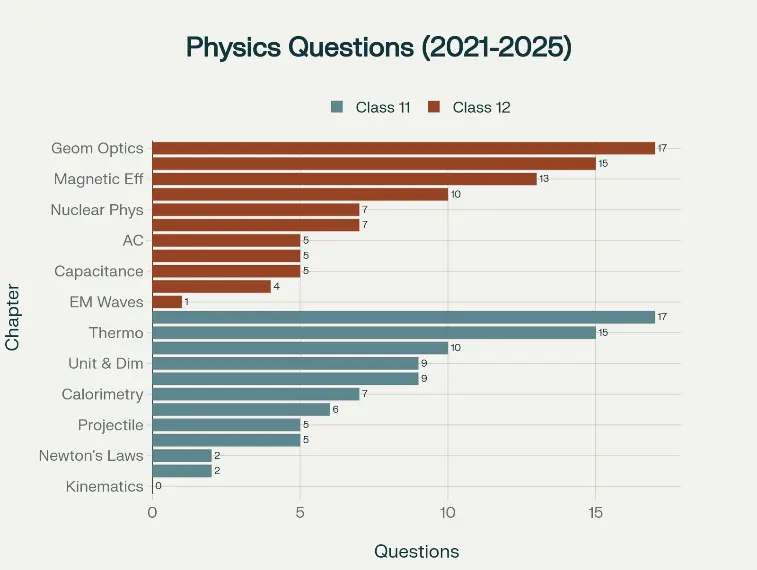
ROI bar graph: Chapter vs Questions Asked in Physics; Highlight 5 – 6 chapters with highest frequencies:–
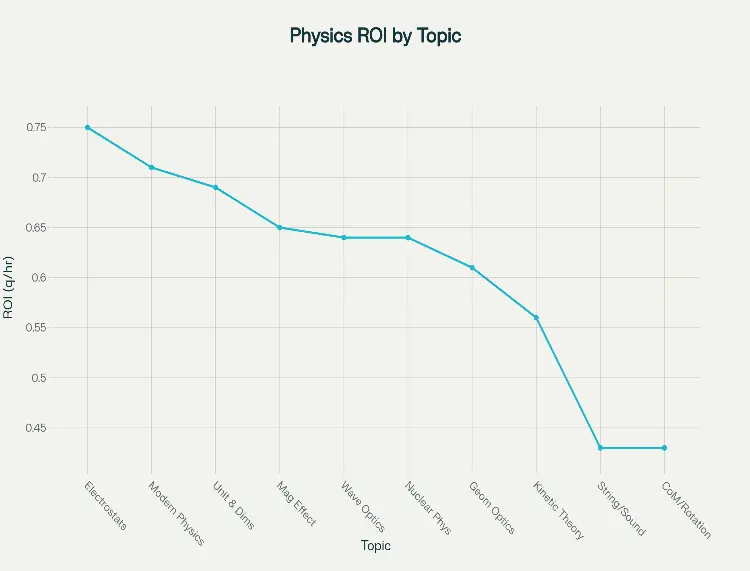
Graph for Visualizing ROI
You can best visualize these ‘quick win’ topics by plotting a scatter chart: Time Invested vs Average Questions. Use this map to target your most rewarding chapters first.
MyExams Tips for Physics
- Focus first on high-frequency chapters e.g., Rotational Motion, Kinetic Theory, Electrostatics, Optics.
- Allocate revision hours to chapters where conceptual clarity often causes mistakes.
- Use mixed-problem-solving sessions to simulate unpredictable Advanced-level question patterns.
Section 3: The Complete Blueprint for JEE Advanced – ‘Chemistry’
Chemistry’s vast syllabus often feels overwhelming, but a systematic plan makes it manageable. Nearly two-thirds of the questions in recent years have come from Class 12, yet Class 11 chapters still carry solid weightage. Success in Chemistry depends not just on learning but on consistent revision, since the subject is packed with facts, reactions, and exceptions.
The master table below breaks down each topic with its 5-year average weightage and the hours suggested for both preparation and revision, so you can balance concept-building with reinforcement.
Following this, the ROI table will point you to the smartest chapters for quick score gains.
1. Chapter-wise Chemistry Blueprint (2021–2025)
The table below breaks down each Chemistry topic, its 5-year average weightage, and the prep/revision hours needed. Use it to create a year-long plan that balances concept-building with consistent reinforcement.
Topic | Class | TotalQuestions (in 5Yrs) | Avg.Questions (in 5Yrs) | PreparationTime (in hrs) | RevisionTime (in hrs) |
| 01. Atomic Structure | 11 | 4 | 0.8 | 18 | 10 |
| 02. Mole Concept | 11 | 3 | 0.6 | 16 | 10 |
| 03. Gaseous State | 11 | 3 | 0.6 | 15 | 10 |
| 04. Redox Reaction and Equivalent Concepts | 11 | 5 | 1 | 12 | 8 |
| 05. Chemical Equilibrium, Ionic Equilibrium | 11 | 7 | 1.4 | 22 | 14 |
| 06. Thermodynamics | 11 | 12 | 2.4 | 18 | 12 |
| 07. Classification of Elements and Periodicity in properties | 11 | 0 | 0 | 20 | 12 |
| 08. Chemical Bonding and Molecular Structure | 11 | 7 | 1.4 | 5 | 2 |
| 09. The s.Block Elements | 11 | 1 | 0.2 | 2 | 1 |
| 10. The p-Block Elements (Boron, Carbon) | 11 | 3 | 0.6 | 6 | 3 |
| 11. IUPAC, Isomerism, GOC, POC | 11 | 4 | 0.8 | 25 | 15 |
| 12. Hydrocarbons | 11 | 5 | 1 | 18 | 12 |
| 13. The Solid State | 11 | 5 | 1 | 14 | 9 |
| 14. Solutions | 12 | 6 | 1.2 | 15 | 9 |
| 15. Electrochemistry | 12 | 9 | 1.8 | 15 | 10 |
| 16. Surface Chemistry | 12 | 4 | 0.8 | 12 | 8 |
| 17. Chemical Kinetics | 12 | 5 | 1 | 16 | 10 |
| 18. General Principles and Processes of Isolation of Elements (Metallurgy) | 12 | 4 | 0.8 | 10 | 4 |
| 19. The p-Block Elements (Oxygen, Nitrogen, Halogen and Inert Gases) | 12 | 11 | 2.2 | 10 | 6 |
| 20. d and f-Block Elements | 12 | 4 | 0.8 | 8 | 3 |
| 21. Coordination Compounds | 12 | 16 | 3.2 | 14 | 6 |
| 22. Qualitative Analysis | 12 | 5 | 1 | 18 | 8 |
| 23. Alkyl Halides | 12 | 4 | 0.8 | 12 | 6 |
| 24. Aldehyde, Ketone and Carboxylic acid | 12 | 17 | 3.4 | 30 | 15 |
| 25. Alcohols, Phenols and Ethers | 12 | 1 | 0.2 | 20 | 18 |
| 26. Aromatic Compounds, Aryl Halides (Haloarenes), Amines | 12 | 16 | 3.2 | 25 | 12 |
| 27. Biomolecules | 12 | 6 | 1.2 | 15 | 6 |
| 28. Polymer | 12 | 2 | 0.4 | 8 | 3 |
| 29. Chemistry in Action | 12 | 1 | 0.2 | 3 | 1 |
| Total | 170 |
2. The High-ROI Hit List: Smart Topics for a Quick Score Boost
Chemistry’s vastness is its biggest challenge. This “Return on Investment” (ROI) list is your secret weapon to counter that.
These high-ROI topics are quicker to prepare yet fetch consistent marks, making them ideal for early coverage. Focus on these to build a strong base score and boost your confidence quickly.
Top 5 High-ROI Topics: Class 11
| Topic/Chapter | Avg. Questions | Total Time (in Hrs) | ROI Score |
| s-Block Elements | 1.2 | 18 | 0.067 |
| Atomic Structure & Nuclear Chemistry | 1.8 | 25 | 0.072 |
| Chemical Bonding | 2.2 | 35 | 0.063 |
| Thermodynamics & Thermochemistry | 2.0 | 35 | 0.057 |
| Hydrocarbons | 1.4 | 35 | 0.040 |
Top 5 High-ROI Topics: Class 12
| Topic/Chapter | Avg. Questions | Total Time (Hrs) | ROI Score |
| Biomolecules & Polymers | 1.2 | 20 | 0.060 |
| Solutions & Colligative Properties | 1.6 | 25 | 0.064 |
| Coordination Compounds | 2.4 | 35 | 0.069 |
| Electrochemistry | 1.8 | 30 | 0.060 |
| Chemical Kinetics | 1.6 | 25 | 0.064 |
3. How to Use These Tables: A Chemist’s Strategy
Start with compact, high-ROI chapters such as Atomic Structure, Hydrocarbons, Solutions, and Coordination Compounds, which give reliable marks for limited hours of work. Then move into heavier blocks like p-Block and Organic Chemistry (Amines, Aldehydes) these take more time but are essential for top ranks. Always pair 3 hours of new learning with at least 1 hour of revision to prevent. information overload.
ROI bar graph: Chapter vs Questions Asked in Chemistry; Highlight 5–6 chapters with highest frequencies:
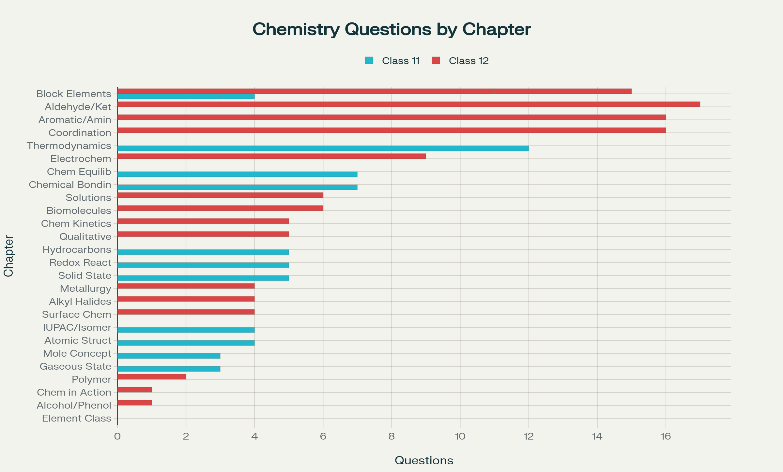
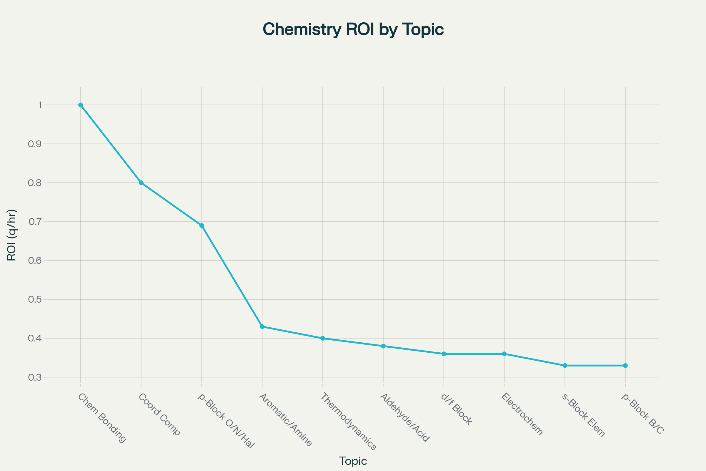
Graph for Visualizing ROI
Just like with Physics, here also you can find a graph between Time Invested vs Average Questions. Use this map to target your most rewarding chapters first.
MyExams Tips for Chemistry
- Begin with concise, high-ROI topics (e.g., Atomic Structure, Coordination Compounds, Biomolecules) to secure early marks.
- Dedicate fixed revision slots to fact-heavy chapters like p-Block and Organic Chemistry.
- Use flashcards or summary sheets to quickly review reactions and exceptions before tests.
Section 4: The Complete Blueprint for JEE Advanced – ‘Mathematics’
Mathematics is the most time-intensive of the three subjects, with the longest preparation hours and high practice demand. Around 61% of the questions in the last five years have been from Class 12, but Class 11 chapters also form a significant base.
The table below gives a chapter-wise view of average weightage along with the prep and revision hours needed, helping you plan your study sessions like a marathon—steady and consistent.
Right after this, the ROI analysis will spotlight chapters that deliver the best marks for the time you spend.
1. Chapter-wise Mathematics Blueprint (2022–2026)
The table below lists every Mathematics topic with its 5-year average weightage and the preparation/revision hours required. Use this as a roadmap to schedule both focused practice sessions and systematic revision.
Topic | Class | TotalQuestions (in 5Yrs) | Avg.Questions (in 5Yrs) | PreparationTime (in hrs) | RevisionTime (in hrs) |
| 01. Basic Mathematics, Logarithm, Quadratic Equations and Inequalities | 11 | 4 | 0.8 | 25 | 8 |
| 02. Trigonometric Functions | 11 | 11 | 2.2 | 30 | 10 |
| 03. Sequence and Series | 11 | 4 | 0.8 | 18 | 5 |
| 04. Permutations and Combinations | 11 | 7 | 1.4 | 20 | 6 |
| 05. Binomial Theorem | 11 | 3 | 0.6 | 12 | 4 |
| 06. Complex Number | 11 | 11 | 2.2 | 20 | 6 |
| 07. Straight Lines | 11 | 4 | 0.8 | 18 | 5 |
| 08. Circle | 11 | 10 | 2 | 18 | 5 |
| 09. Conic Section | 11 | 11 | 2.2 | 28 | 10 |
| 10. Set & Relation, Statistics | 11 | 3 | 0.6 | 15 | 6 |
| 11. Function | 12 | 4 | 0.8 | 25 | 8 |
| 12. Inverse Trigonometric Functions | 12 | 6 | 1.2 | 15 | 4 |
| 13. Limit of Functions | 12 | 6 | 1.2 | 15 | 4 |
| 14. Continuity and Derivability, MOD | 12 | 3 | 0.6 | 22 | 10 |
| 15. Application of Derivatives | 12 | 16 | 3.2 | 30 | 12 |
| 16. Integration | 12 | 10 | 2 | 35 | 20 |
| 17. Area Under Curve | 12 | 7 | 1.4 | 10 | 3 |
| 18. Differential Equations | 12 | 8 | 1.6 | 15 | 4 |
| 19. Vectors | 12 | 10 | 2 | 25 | 8 |
| 20. Three-Dimensional Geometry | 12 | 7 | 1.4 | 18 | 5 |
| 21. Matrices | 12 | 6 | 1.2 | 18 | 5 |
| 22. Determinants | 12 | 8 | 1.6 | 10 | 3 |
| 23. Probability | 12 | 17 | 3.4 | 20 | 8 |
| Total | 176 |
2. The High-ROI Hit List: The Smartest Path to a Higher Score
While full coverage is essential, some chapters consistently give high returns for the time invested. Tackling these high-ROI topics early ensures scoring opportunities and builds confidence for the tougher parts of the syllabus.
Top 4 High-ROI Topics: Class 11
| Topic/Chapter | Avg. Questions | Total Time (Hrs) | ROI Score |
| Binomial Theorem | 1.0 | 23 | 0.043 |
| Sequence & Series | 1.6 | 30 | 0.053 |
| Permutation & Combination | 1.2 | 30 | 0.040 |
| Complex Numbers | 1.6 | 35 | 0.046 |
Top 5 High-ROI Topics: Class 12
| Topic/Chapter | Avg. Questions | Total Time (Hrs) | ROI Score |
| Matrices & Determinants | 2.0 | 30 | 0.067 |
| Vectors & 3D Geometry | 2.4 | 40 | 0.060 |
| Probability | 1.8 | 30 | 0.060 |
| Differential Equations | 1.2 | 28 | 0.043 |
| Application of Derivatives | 2.2 | 35 | 0.063 |
3. How to Use These Tables: The Mathematician’s Game Plan
Start with logical, formula-driven chapters such as Matrices & Determinants, Probability, and Vectors & 3D Geometry, which are relatively scoring and predictable.
Gradually move into the marathon topics like Calculus (Integration, Application of Derivatives, Differential Equations) that require more practice but are critical for top ranks. Interleave light and heavy chapters in your weekly plan to avoid fatigue and ensure consistent progress.
ROI bar graph: Chapter vs Questions Asked in Mathematics; Highlight 5–6 chapters with highest frequencies
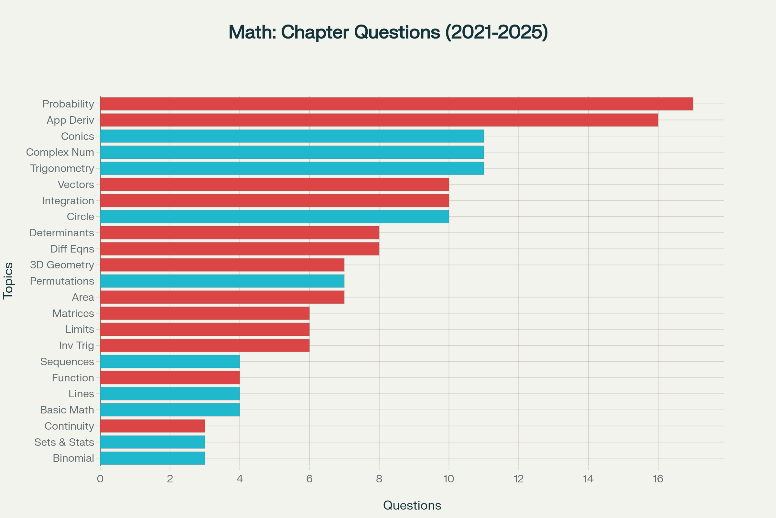
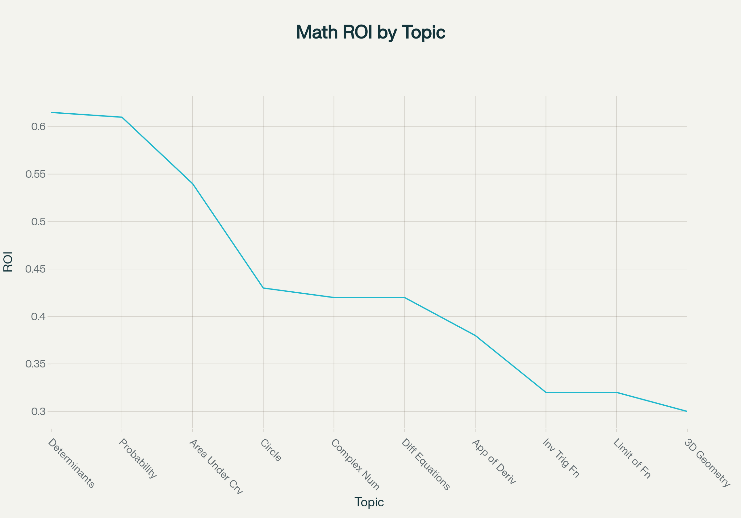
Graph for Visualizing ROI
In Mathematics also you can find a graph between Time Invested vs Average Questions. Use this map to target your most rewarding chapters first.
Math Strategic Takeaways
- Secure scoring chapters first (Matrices & Determinants, Probability, Vectors & 3D).
- Dedicate daily practice to Calculus it’s the backbone of the paper and demands volume.
- Maintain a personal formula sheet and error log and revisit it before every practice test.
Section 5: Smart Weekly Prep & Revision Plan
The biggest insight from the 5-year data is simple: success comes from balance, not only by Hard work. A consistent, structured plan ensures that all three subjects get their fair share of focus without getting exhaust. Here’s a MyExams.AI-backed, data-driven weekly study proposal:
| Subject | Study Hrs/Wk | Prep % | Rev Hrs/Wk | Rev. % (of Prep.) |
| Physics | 14–16 | 32% | 4-5 | 27% |
| Chemistry | 12–14 | 28% | 4 | 27% |
| Mathematics | 16–18 | 36% | 5 | 27% |
| Total | 42–48 | 100% | 13–14 |
How To Use the Plan:
- Mix tough and light topics in the same week to keep energy levels steady.
- Prioritize weekly revision of Class 11—it tends to fade faster under the weight of Class 12 prep.
- Stick to the plan flexibly: adjust hours, but never skip revision.
Final Takeaways
- Start with high-frequency, high-ROI chapters across all subjects.
- Use revision hours surgically Class 11 and tricky topics, not just recent syllabus.
- Attempt full-length, mixed-section mocks to build real exam stamina.
- Don’t skip “low-weightage” chapters; they often bring easy bonus marks.
- Track your errors, maintain a log, and revisit it regularly to avoid repeating mistakes under pressure.
FAQs:
Q.1 How many questions are usually from Class 11 and Class 12 in JEE Advanced?
A: Over the last 5 years, about 41% (214) were from Class 11, and 59% (310) from Class 12, so both need focus.
Q.2 What’s the role of PYQs in prep?
A: Solving previous years’ JEE Advanced questions is the closest simulation to real exam difficulty and helps spot high-yield topics.
Q.3 How do I plan revision for JEE Advanced?
A: Use data-driven chapter prioritization, dedicate 25–30% of study time weekly to revision, and track errors for improvement.
Q.4 Should I give equal time to all three subjects every week?
A: Not necessarily. Follow the data-backed weekly plan: Approx. 13 hrs for Chemistry, approx. 12.5 hrs for Mathematics, and approx. 9 hrs for Physics. The idea is balance, not uniformity, different subjects demand different effort.
Q.5 Are “low-weightage” chapters worth covering?
A: Yes. Even chapters that contribute just 1–2 questions can provide easy marks. Skipping them could cost you a rank edge, especially when competition is close.
Sum-up
This blog, powered by MyExams.AI’s 5-year trend analysis – is your expert-backed roadmap to cracking JEE Advanced. Treat every hour as an investment: prepare with real data, revise smart, and stay consistent.
In short, a disciplined weekly schedule (approx. 45 hrs study + 13 hrs revision), a focus on high-ROI chapters, and consistent mock practice form the data-backed formula for cracking JEE Advanced. It’s not just about how hard you work, but where and how you put your effort.
Wishing every aspirant a strategic and successful JEE journey!
Best Available Test Series for JEE Advanced-2026… Highly recommended.