
JEE Main Chapter Wise Weightage Last 5 Years

Introduction
JEE Main is the primary entrance exam for admission to NITs, IIITs, and GFTIs. Every year, more than 10 lakh students appear for the exam, making competition intense. This page presents a chapter-wise weightage analysis based on the last five years of JEE Main papers (2021–2025) and explains how students can use these trends to plan their preparation effectively.
In today’s competitive era, it is important to understand exam patterns, identify high-weightage chapters, and allocate your preparation time accordingly. Strategic preparation is the real game changer. That’s exactly what this blog helps you do.
● LIVE UPDATE
JEE Main 2026 Session 1 Answer Key Released
Check Now →
This blog offers a detailed subject-wise, class-wise, and chapter-wise analysis of the last five years of JEE Main papers (2021–2025), including:
- Average number of questions asked per chapter
- Class-wise contribution to the paper
- ROI (Return on Investment): Questions per hour of preparation
- Smart strategy for preparation and revision
With subject-specific insights for Physics, Chemistry, and Mathematics, we break down chapter trends, question frequency, and suggested time allocation for both learning and revision. By the end, you’ll be able to prioritize high-yield chapters, manage your study hours wisely, and avoid common prep mistakes all backed by real exam data.
1. Subject-Wise Overview of JEE Main
JEE Main includes 75 questions (25 from each subject). Out of 25 Questions 20 are MCQ-based and 5 questions are of Numerical Value Type. Each subject contributes equally in terms of marks. However, the level of conceptual depth, numerical solving, and trickiness varies across subjects.
| Subject | Class 11 | Class 12 | Total Ques. | Difficulty Trend |
| Physics | 12 | 13 | 25 | Concept-heavy, Moderate |
| Chemistry | 10 | 15 | 25 | Memory + Concept-mix |
| Mathematics | 11 | 14 | 25 | Lengthy, Tough, Calculation-based |
Class-wise Weightage Overview (2021–2025)
based on the average frequency of questions from Class 11 and 12
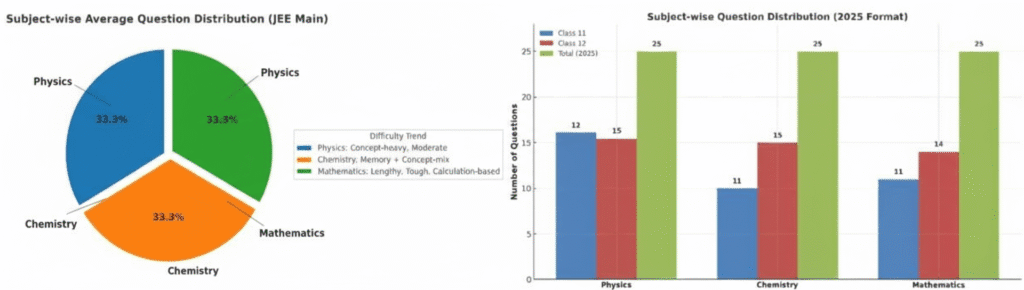
Insight: While Class 12 chapters show slightly higher question count in Physics, Class 11 remains dominant in Chemistry, and for Mathematics, it stays nearly balanced across both classes.
Subject-wise Level of Difficulty (2021 to 2025)
Over the last five years (2021–2025), the difficulty levels of jee advanced syllabus have shown interesting patterns. Physics has remained moderately consistent with a slight dip in 2025. Chemistry has generally been student-friendly, except for a tougher shift in 2025. Mathematics has consistently been the most challenging subject, with fluctuating but overall high difficulty. Based on this trend, it is advisable for students to focus on building strong conceptual clarity in Physics, prioritize NCERT and revision in Chemistry, and invest more time in practicing lengthy, calculation-heavy questions in Mathematics. Smart planning with subject-specific strategies can help to navigate the paper more effectively and boost scores.
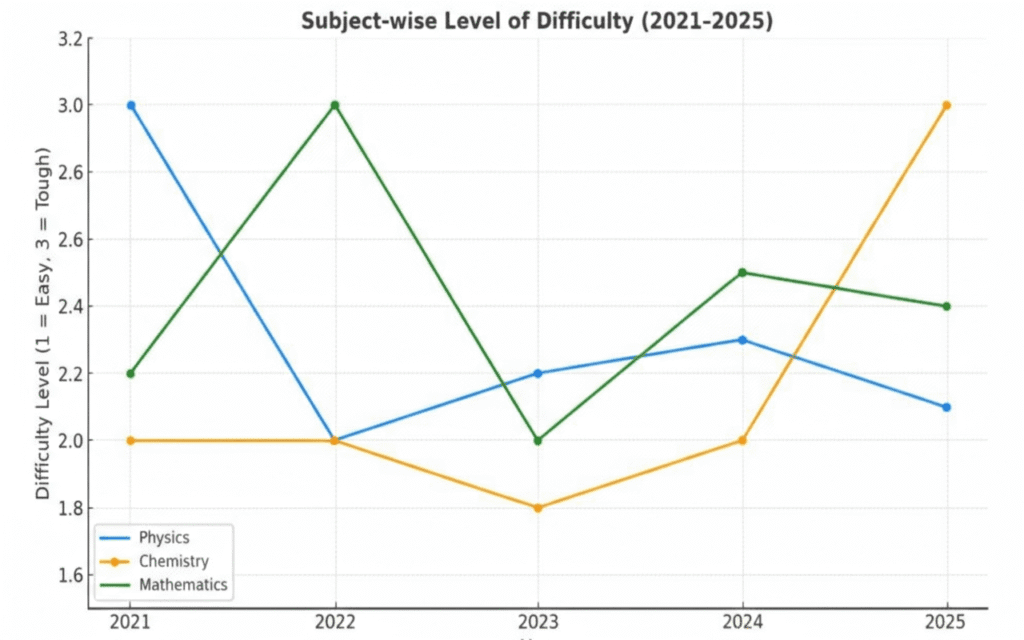
| Subjects | 2021 | 2022 | 2023 | 2024 | 2025 | Avg. |
| Physics | 3 | 2 | 2.2 | 2.3 | 2.1 | 2.32 |
| Chemistry | 2 | 2 | 1.8 | 2 | 3 | 2.16 |
| Mathematics | 2.2 | 3 | 2 | 2.5 | 2.4 | 2.42 |
(1- Easy, 2- Moderate, 3- Tough)
2. Physics: A Balanced Mix of Concept & Time Strategy for JEE Main
Physics in the JEE Main is often perceived as a blend of logic, concepts, and calculations, and data from the last five years (2021 to 2025) confirms this. With an average of 30 questions every year, Physics has shown a moderate difficulty level (Average: 2.32 out of 3), meaning it’s neither too easy nor overly tough, but requires smart conceptual clarity.
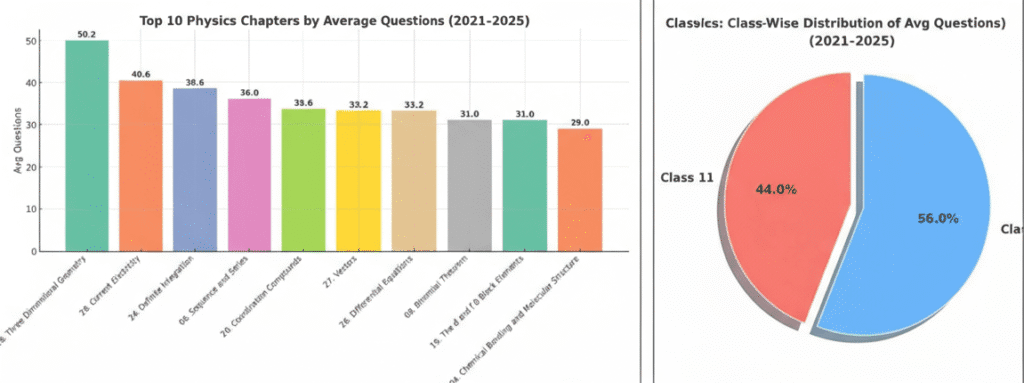
Class 12 slightly dominates the paper with 56% weightage, but Class 11 isn’t far behind. Chapters such as Current Electricity, Rotational Motion, Kinetic Theory of Gases, and Moving Charges & Magnetism have emerged as high-weightage, high-ROI areas, contributing more than 20 questions over five years.
However, not all chapters are equal. Some, like Relative Motion or Thermal Expansion, carry fewer questions, but they still form the foundation of bigger concepts. Preparation should be time-optimized – focus more time (almost 15 – 19 hours) on chapters with high frequency and tougher understanding, while allotting revision hours smartly (approx. 3–7 hrs) based on question trends.
MyExams Tip: Prioritize chapters with both high frequency and high conceptual demand. Solve PYQs topic-wise to identify patterns and avoid traps. Don’t ignore the NCERT for theory, especially for scoring in conceptual MCQs.
Overall, strategic planning, supported by real data, gives you the edge, not just hard work alone.
Class 11 and 12: Chapters to Prioritize in Physics: Based on 5-year trends, here is the class-wise breakdown:
PHYSICS | Class | Total Ques in the last 5 years | Average Ques per year | Hours Required for Preparation | Hours Required for Revision |
| 01. Units and Measurement | 11 | 84 | 16.8 | 9 | 3 |
| 02. Vector | 11 | 29 | 5.8 | 9 | 3 |
| 03. Motion in a Straight Line | 11 | 65 | 13 | 11 | 4 |
| 04. Relative Motion | 11 | 9 | 1.8 | 11 | 4 |
| 05. Projectile | 11 | 50 | 10 | 11 | 4 |
| 06. Newton’s Laws of Motion | 11 | 72 | 14.4 | 13 | 5 |
| 07. Friction | 11 | 25 | 5 | 13 | 5 |
| 08. Circular Motion | 11 | 37 | 7.4 | 9 | 5 |
| 09. Work. Power and Energy | 11 | 68 | 13.6 | 15 | 6 |
| 10. Centre of Mass | 11 | 66 | 13.2 | 15 | 6 |
| 11. Rotational Motion | 11 | 131 | 26.2 | 19 | 7 |
| 12. Gravitation | 11 | 99 | 19.8 | 11 | 4 |
| 13. Oscillations | 11 | 82 | 16.4 | 13 | 5 |
| 14. String Waves | 11 | 26 | 5.2 | 11 | 4 |
| 15. Soundwaves | 11 | 43 | 8.6 | 9 | 3 |
| 16. Calorimetry | 11 | 15 | 3 | 11 | 4 |
| 17. Heat Transfer | 11 | 16 | 3.2 | 11 | 4 |
| 18. Kinetic Theory of Gases | 11 | 121 | 24.2 | 15 | 5 |
| 19. Thermodynamics | 11 | 102 | 20.4 | 15 | 5 |
| 20. Elasticity | 11 | 64 | 12.8 | 15 | 5 |
| 21. Thermal Expansion | 11 | 9 | 1.8 | 15 | 5 |
| 22. Fluid Mechanics | 11 | 43 | 8.6 | 11 | 4 |
| 23. Surface Tension | 11 | 40 | 8 | 9 | 3 |
| 24. Viscosity | 11 | 16 | 3.2 | 9 | 3 |
| 25. Electric Charges and Fields | 12 | 113 | 22.6 | 11 | 4 |
| 26. Electrostatic Potential | 12 | 42 | 8.4 | 11 | 4 |
| 27. Capacitance | 12 | 83 | 16.6 | 11 | 4 |
| 28. Current Electricity | 12 | 203 | 40.6 | 13 | 5 |
| 29. Moving Charge and Magnetism | 12 | 138 | 27.6 | 15 | 6 |
| 30. Electromagnetic Induction | 12 | 83 | 16.6 | 16 | 7 |
| 31. Alternating Current | 12 | 112 | 22.4 | 11 | 5 |
| 32. Ray Optics and Optical Instruments | 12 | 116 | 23.2 | 17 | 7 |
| 33. Wave Optics | 12 | 82 | 16.4 | 11 | 4 |
| 34. Magnetism and Matter | 12 | 38 | 7.6 | 9 | 3 |
| 35. Electromagnetic Waves | 12 | 78 | 15.6 | 9 | 3 |
| 36. Nuclear Physics | 12 | 55 | 11 | 9 | 3 |
| 37. Solid and Semiconductor Devices | 12 | 121 | 24.2 | 17 | 7 |
| 38. Atoms | 12 | 95 | 19 | 9 | 3 |
| 39. Dual Nature of Matter and Radiation | 12 | 106 | 21.2 | 9 | 3 |
| 40. Error Analysis in Experiments | 12 | 63 | 12.6 | 9 | 3 |
Physics: ROI-Based Preparation Strategy
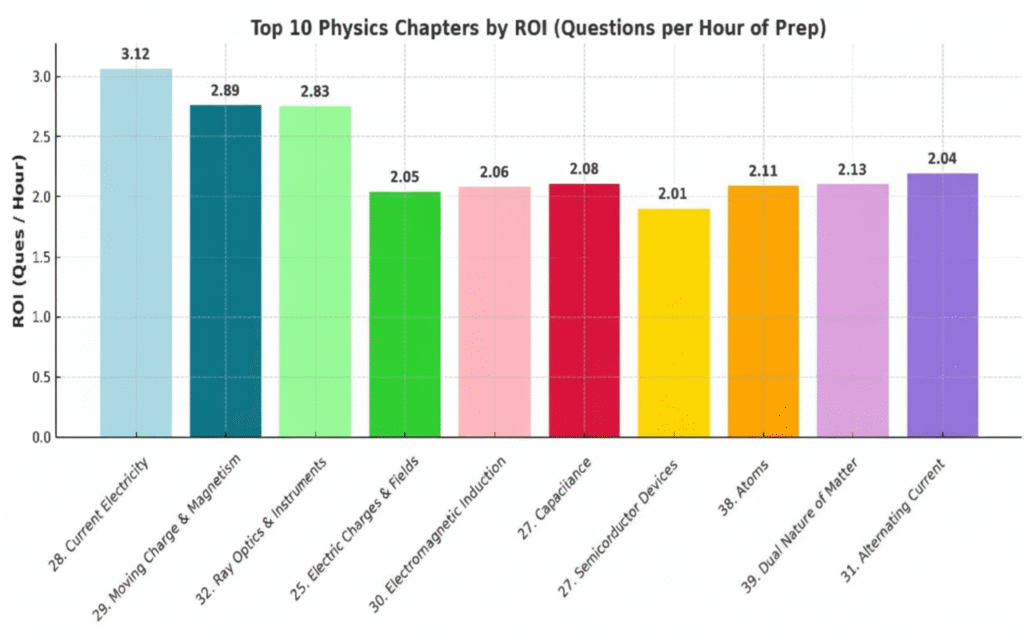
- Start with high-ROI chapters that consistently offer more questions for less prep time.
- Avoid time-draining chapters unless you have completed high-return ones; aim for maximum score with minimum effort.
- Regularly revisit the ROI trend to update your strategy based on changing weightage and evolving paper patterns.
- Bar Graph: High ROI Topics in Physics
3. Chemistry: Trends & Focused Strategy Backed by Data
Chemistry, often viewed as the most scoring subject in JEE Main, offers a perfect balance between theory and application, provided students approach it with the right strategy. A mix of right theory, NCERT facts, and concept application defines this section. A close look at the last five years of JEE Main papers (2021–2025) reveals that Chemistry maintains a nearly even distribution between Class 11 and Class 12 chapters. The weightage, however, slightly tilts in favour of Class 12, especially in Organic and Physical Chemistry.
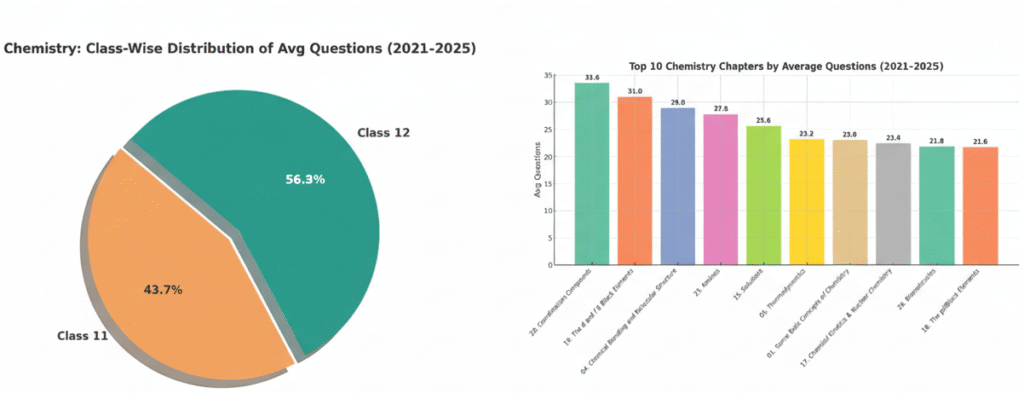
From a preparation point of view, chapters like Chemical Bonding, Coordination Compounds, Thermodynamics, and Redox Reactions consistently show high question frequency and offer strong Return on Investment (ROI) in terms of questions per hour of preparation. On the other hand, lengthy chapters such as Organic Chemistry – Reaction Mechanism demand deeper conceptual clarity and revision cycles.
What makes Chemistry unique is its mixed nature; some chapters are fact-based (good for quick scoring), while others are concept-heavy (ideal for application-based questions). Our data also show that Chemistry has had the lowest average difficulty level (2.16) among all three subjects.
MyExams Tip: Focus first on high-ROI chapters, especially from Class 12. Build a strong foundation in NCERT concepts, revise regularly, and solve previous year papers. With the right topic prioritization, Chemistry can easily become your scoring anchor in the JEE Main journey.
Class 11 and 12: Chapters to Prioritize in Chemistry: Based on 5-year trends, here is the class-wise breakdown:
CHEMISTRY | Class | Total Ques in the last 5 years | Average Ques per year | Hours Required for Preparation | Hours Required for Revision | |
| 01. Some Basic Concepts of Chemistry | 11 | 115 | 23 | 9 | 6 | |
| 02. Structure of Atom | 11 | 105 | 21 | 12 | 7 | |
| 03. Classification of Elements and Periodicity in Properties. | 11 | 76 | 15.2 | 8 | 3 | |
| 04. Chemical Bonding and Molecular Structure | 11 | 145 | 29 | 16 | 7 | |
| 05. Thermodynamics | 11 | 116 | 23.2 | 16 | 8 | |
| 06. Chemical Equilibrium | 11 | 54 | 10.8 | 9 | 5 | |
| 07. Ionic Equilibrium | 11 | 59 | 11.8 | 14 | 8 | |
| 08. Redox Reactions | 11 | 49 | 9.8 | 9 | 6 | |
| 09. The p-Block Elements | 11 | 41 | 8.2 | 6 | 2 | |
| 10. IUPAC | 11 | 36 | 7.2 | 8 | 3 | |
| 11. General Organic Chemistry | 11 | 84 | 16.8 | 12 | 3 | |
| 12. Isomerism | 11 | 40 | 8 | 8 | 3 | |
| 13. Hydrocarbons | 11 | 64 | 12.8 | 14 | 6 | |
| 14. Practical Organic Chemistry | 11 | 76 | 15.2 | 5 | 2 | |
| 15. Solutions | 12 | 128 | 25.6 | 10 | 6 | |
| 16. Electrochemistry | 12 | 102 | 20.4 | 10 | 7 | |
| 17. Chemical Kinetics & Nuclear Chemistry | 12 | 112 | 22.4 | 12 | 8 | |
| 18. The p-Block Elements | 12 | 108 | 21.6 | 8 | 4 | |
| 19. The d and f-Block Elements | 12 | 155 | 31 | 10 | 5 | |
| 20. Coordination Compounds | 12 | 168 | 33.6 | 13 | 6 | |
| 21. Qualitative Analysis | 12 | 70 | 14 | 11 | 5 | |
| 22. Haloalkanes and Haloarenes | 12 | 85 | 17 | 8 | 3 | |
| 23. Alcohols. Phenols and Ethers | 12 | 53 | 10.6 | 12 | 4 | |
| 24. Aldehyde. Ketones and Carboxylic Acids | 12 | 95 | 19 | 16 | 5 | |
| 25. Amines | 12 | 139 | 27.8 | 12 | 4 | |
| 26. Biomolecules | 12 | 109 | 21.8 | 8 | 3 | |
| 27. Polymers | 12 | 42 | 8.4 | 5 | 2 | |
Chemistry: ROI-Based Preparation Strategy
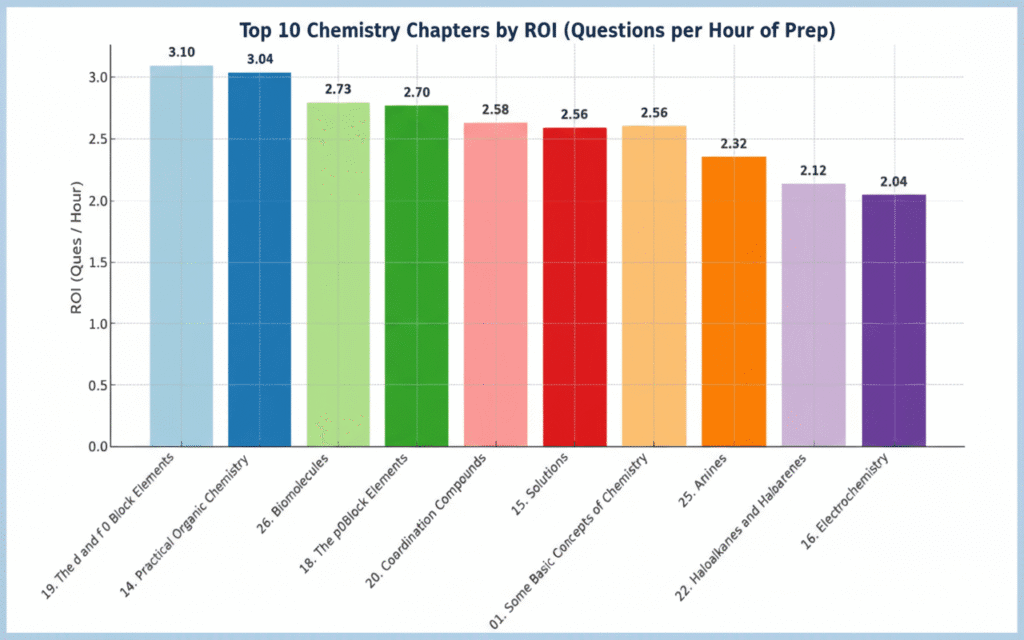
- Distribute your prep hours wisely avoid spending too much time on low-ROI chapters, especially in the final prep phase.
- Follow the 60:30:10 rule 60% time on high-ROI chapters, 30% on average ones, and 10% only if time allows for lesser-return topics.
- Reinforce through quick-revision tables, PYQs, and flashcards a high-ROI strategy doesn’t just depend on what you study, but how you revise.
- Bar Graph: High ROI Topics in Chemistry
4. Mathematics: Accuracy, Speed & Smart Topic Selection
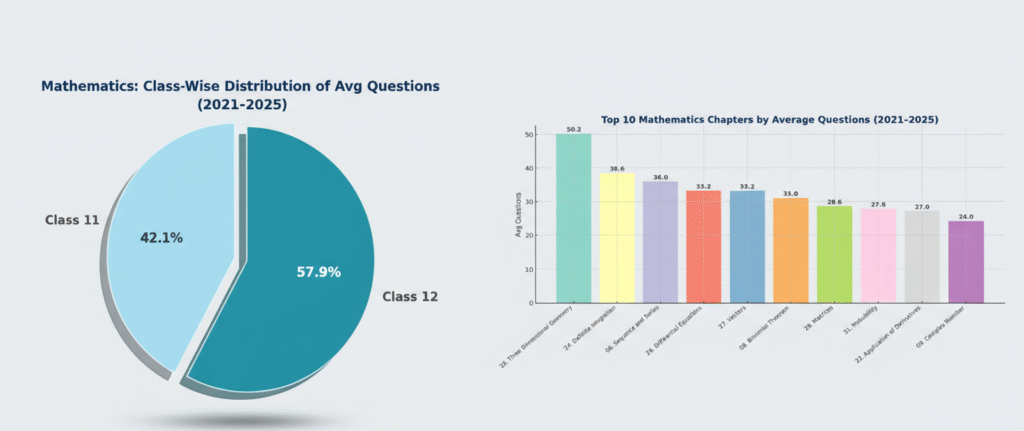
Maths is lengthy and demands both accuracy and speed. Time management and mastery over formula-based applications are key.
Mathematics often emerges as the most challenging subject in JEE Main, not necessarily due to complex concepts, but because of the lengthy calculations and time pressure. Analysing the past five years of paper trends (2021–2025), we find that Mathematics has maintained the highest average difficulty level (2.42) among all three subjects.
However, smart preparation can drastically improve outcomes. Our data show that chapters like Relation, Binomial Theorem, 3D Geometry, and Area Under Curve deliver high ROI (over 3 questions per hour of prep). This means with less effort, students can gain more marks, a goldmine for those short on time. Chapters such as Definite Integration, Differential Equations, Determinants, and Statistics also feature in the top 10 list of ROI, and have consistently appeared in past papers. Conversely, topics such as Complex Numbers, Matrices, and Coordinate Geometry require longer preparation time but are essential for in-depth concept mastery and problem-solving techniques.
MyExams Tip: Start with high-ROI chapters to build confidence and momentum. Practice mock tests regularly to build speed and accuracy under time pressure. Focus on formula retention and shortcut techniques to reduce silly mistakes. With the right planning, Mathematics can shift from being a feared subject to your highest-scoring one.
Class 11 and 12: Chapters to Prioritize in Maths: Based on 5-year trends, here is the class-wise breakdown:
Mathematics | Class | Total Ques in the last 5 years | Average Ques per year | Hours Required for Preparation | Hours Required for Revision |
| 01. Basic Mathematics and Logarithm | 11 | 12 | 2.4 | 6 | 2 |
| 02. Trigonometric Ratios and Identities | 11 | 37 | 7.4 | 9 | 3 |
| 03. Trigonometric Equations | 11 | 39 | 7.8 | 7 | 2 |
| 04. Solution of a Triangle | 11 | 13 | 2.6 | 7 | 2 |
| 05. Quadratic Equations and Inequalities | 11 | 90 | 18 | 15 | 4 |
| 06. Sequence and Series | 11 | 180 | 36 | 15 | 4 |
| 07. Permutations and Combinations | 11 | 119 | 23.8 | 16 | 4 |
| 08. Binomial Theorem | 11 | 155 | 31 | 9 | 3 |
| 09. Complex Number | 11 | 120 | 24 | 16 | 5 |
| 10. Straight Lines | 11 | 97 | 19.4 | 15 | 4 |
| 11. Circle | 11 | 98 | 19.6 | 15 | 4 |
| 12. Parabola | 11 | 76 | 15.2 | 9 | 4 |
| 13. Ellipse | 11 | 64 | 12.8 | 6 | 2 |
| 14. Hyperbola | 11 | 57 | 11.4 | 6 | 2 |
| 15. Set | 11 | 22 | 4.4 | 3 | 1 |
| 15. Relation | 11 | 55 | 11 | 3 | 1 |
| 16. Statistics | 11 | 75 | 15 | 6 | 2 |
| 17. Function | 12 | 96 | 19.2 | 20 | 6 |
| 18. Inverse Trigonometric Functions | 12 | 73 | 14.6 | 15 | 4 |
| 19. Limit of Functions | 12 | 66 | 13.2 | 12 | 3 |
| 20. Continuity and Derivability | 12 | 83 | 16.6 | 16 | 5 |
| 21. Methods Of Differentiation | 12 | 40 | 8 | 9 | 4 |
| 22. Application of Derivatives | 12 | 135 | 27 | 30 | 10 |
| 23. Indefinite Integration | 12 | 38 | 7.6 | 15 | 4 |
| 24. Definite Integration | 12 | 193 | 38.6 | 20 | 6 |
| 25. Area Under Curve | 12 | 107 | 21.4 | 7 | 3 |
| 26. Differential Equations | 12 | 166 | 33.2 | 12 | 4 |
| 27. Vectors | 12 | 166 | 33.2 | 25 | 8 |
| 28. Three-Dimensional Geometry | 12 | 251 | 50.2 | 15 | 5 |
| 29. Matrices | 12 | 143 | 28.6 | 18 | 6 |
| 30. Determinants | 12 | 87 | 17.4 | 6 | 3 |
| 31. Probability | 12 | 139 | 27.8 | 18 | 6 |
Mathematics: Chapter-Wise Average & Strategy
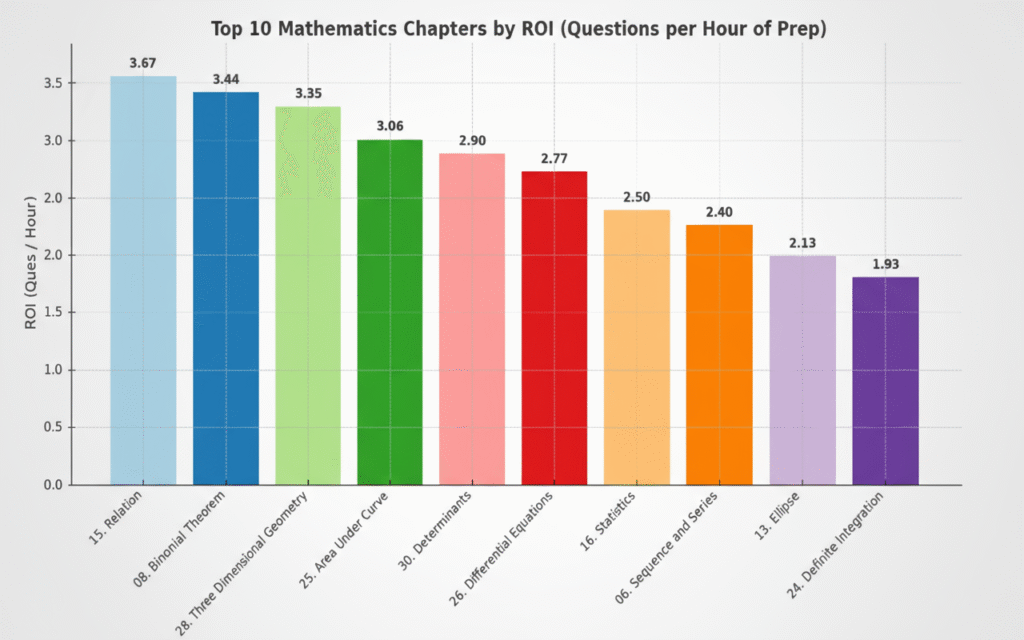
- Prioritize chapters with high to low ROI; these offer the best score booster for your effort.
- Use focused formula sheets, and concept map math rewards clarity and repeated exposure to common question patterns.
- Adopt a “smart solve” approach first practice questions from high-ROI areas, then attempt full-length papers for time management.
- Revise using error logs and mock analysis track mistakes from high-weightage topics to fine-tune accuracy in real exams.
- Bar Graph: High ROI Topics in Mathematics
5. Take Away: Expert Strategy for Smart Study & Revision
Across all three subjects, the key is smart effort. Use this analysis to prepare a weekly subject mix, alternating between tough and light topics. Focus more time on high-weightage chapters and don’t ignore the revision.
Suggested Weekly Study Plan: Based on our insights, MyExams.Ai experts recommend the following time distribution strategy:
| Subject | Study Hours/Week | Prep Time (%) | Revision Hours/Week | Revision Time (%) |
| Physics | 14–16 hrs | 35% | 4–5 hrs | 30% |
| Chemistry | 12–14 hrs | 30% | 4 hrs | 35% |
| Mathematics | 16–18 hrs | 35% | 5 hrs | 35% |
Key Expert Advice:
- Allocate more time to high ROI chapters across subjects.
- Use revision hours for Class 11 chapters that fade over time.
- Practice mixed-topic mock tests to boost retention.
- Don’t ignore low-weight chapters; they often hold easy marks.
Frequently Asked Questions (FAQs)
1: How important is the Class 11 syllabus for JEE Main 2026?
Ans: It is crucial, but no need to obsess over it equally. The data from the last five years shows a split: Class-12 chapters dominate Physics and Maths, while Class 11 actually holds the upper hand in Chemistry. You can’t just rely on your current Class 12 studies. You need a revision plan that keeps Class 11 topics like Thermodynamics & Equilibrium fresh, or you risk losing easy marks.
2: Which chapters are the “Must-Do” for a high score in JEE Main?
Ans: If you want the best return on your time, look at the High-ROI list. In Physics, Current Electricity and Rotational Motion are heavyweights. For Chemistry, Coordination Compounds and the d or f Block are non-negotiable. Maths is all about 3D Geometry and Binomial Theorem. These chapters appear consistently and often have predictable question patterns, making them your safest bet for a score boost.
3: Is NCERT enough for JEE Main Chemistry?
Ans: For a major part of the paper, yes. Our trend analysis shows Chemistry is the most scoring subject with a “moderate’’ difficulty rating (2.16). A lot of this comes from direct fact-based questions in Inorganic and Physical Chemistry. Read the NCERT line-by-line for chapters like Biomolecules, and p-Block. However, for Physical Chemistry, you will definitely need to practice numerical problems beyond just the textbook.
4: Maths is too lengthy. How should I manage my time during the exam?
Ans: You are not alone; Maths is consistently rated the toughest section (2.42 difficulty). The trick isn’t to solve everything, but to choose wisely. Start with “quick kill’’ chapters like Statistics, Matrices, or 3D Geometry where the steps are standard. Leave the twisted, calculus-heavy problems for the end. It is better to solve 15 questions accurately than to get stuck on 3 hard ones and lose 20 minutes.
5: What is the “60:30:10 Rule” mentioned in the strategy?
Ans: This is a simple way to prioritize your study hours. Spend 60% of your available time mastering the High-ROI chapters we listed; these give you the bulk of your marks. Allocate 30% to the average-weightage topics. The final 10% is for those low-yield chapters; only touch them if you have extra time. This ensures you aren’t wasting hours on a topic that might not even appear in the paper.
6: How does MyExams.Ai help with this data-driven preparation?
Ans: Knowing the data is one thing while using it is another. We don’t just give you a static list. The MyExams.Ai app lets you practice specific ‘‘High-ROI” chapter tests, tracks your speed on lengthy Maths problems, and helps you fix your weak spots with targeted analytics. It basically forces you to follow this smart strategy every single day until the exam.
Final Note:
This analysis empowers students with clarity, focus, and confidence. Prioritize chapters strategically, revise smartly, and let the data guide your JEE Main preparation in 2025.
Stay consistent… Study smart… and stay tuned with MyExams.Ai for more expert-backed academic insights.