
NEET Cracking Blueprint: In-Depth Chapter Trend Analysis & Strategy (2021–2025)

Introduction
Cracking NEET isn’t just about studying hard it’s about studying smart. Every serious aspirant knows that blindly following the NCERT syllabus is not enough. You must understand which chapters matter the most, how many questions typically appear, and where your effort brings the maximum return. This blog is a deep, data-backed dive into the last 5 years of NEET (2021–2025), analysing trends, question frequency, difficulty levels, and time investment for each subject individually Physics, Chemistry and Biology.
Whether you’re a fresh aspirant, a dropper, or someone who is juggling school with NEET preparation, this guide will help you realign your strategy for better results. It will also help you decide where to focus, how to revise and what to skip to optimise your score.
Part 1: Overall Subject-Wise Analysis
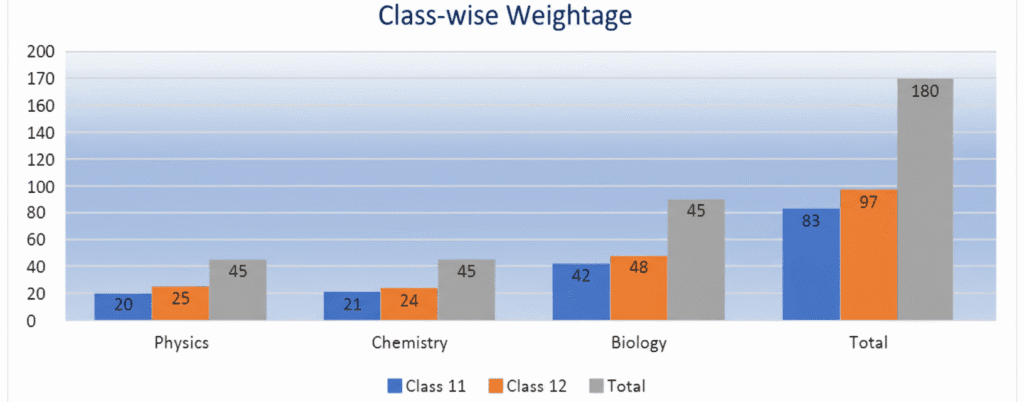
Let’s start with the overview of exam. Each NEET paper includes 180 questions 90 from Biology, and 45 each from Chemistry and Physics. The subject weightage has remained fairly consistent over the last five years:
| Subject | Avg. No. of Questions | Difficulty Trend |
| Physics | 45 | Toughest for most students |
| Chemistry | 45 | Conceptual + NCERT-based |
| Biology | 90 | Moderate to Easy |
Class-Wise Weightage (2021–2025 Avg.)
| Class | Biology | Chemistry | Physics |
| Class 11 | 42 | 21 | 20 |
| Class 12 | 48 | 24 | 25 |
Insight: Class 12 chapters, especially in Physics and Chemistry, carry slightly more weight. However, Class 11 chapters are crucial for building foundational understanding and shouldn’t be skipped.
Part-2_Physics Insights: Chapter-wise Question Trends & Prep Strategy
Subject Nature: More Conceptual, Application-Based
Physics is often the lowest-scoring subject for NEET aspirants, not only due to its analytical nature and difficulty level, but also due to poor time management. Many students spend more time on low-weightage chapters while ignoring or giving less priority to high-return topics. However, the right chapter selection can help aspirants to score smartly. Let’s change that.
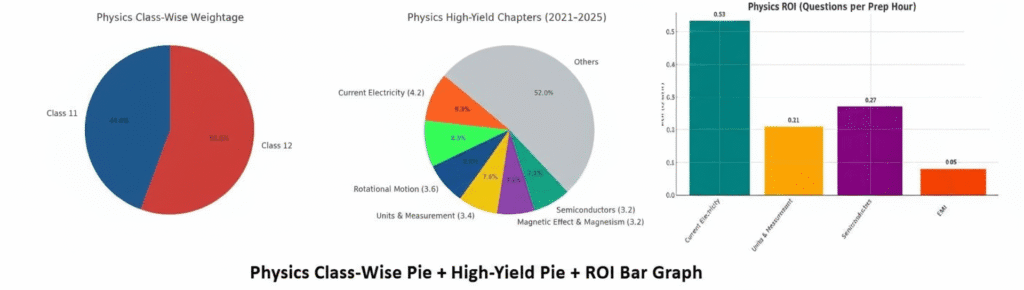
Physics Class-Wise Pie + High-Yield Pie + ROI Bar Graph
Class 11: Chapters to Prioritize in Physics
| S.No | Chapter Name | Class | Avg. Questions per Year | Prep Hours | Revision Hours |
| 1 | Units and Measurement | 11 | 3.4 | 16 | 4 |
| 2 | Motion in a Straight Line (Kinematics) | 11 | 1.8 | 18 | 6 |
| 3 | Motion in a Plane | 11 | 1.0 | 20 | 7 |
| 4 | Laws of Motion | 11 | 1.6 | 20 | 8 |
| 5 | Work, Power, and Energy | 11 | 1.4 | 20 | 8 |
| 6 | Motion of a System of Particles & Rotational Motion | 11 | 3.6 | 24 | 10 |
| 7 | Gravitation | 11 | 2.8 | 14 | 4 |
| 8 | Mechanical Properties of Solids (Elasticity) | 11 | 0.8 | 6 | 2 |
| 9 | Mechanical Properties of Fluid | 11 | 1.4 | 8 | 3 |
| 10 | Thermal Properties of Matter | 11 | 0.8 | 10 | 4 |
| 11 | Thermodynamics | 11 | 1.0 | 10 | 4 |
| 12 | Kinetic Theory of Gases | 11 | 1.0 | 8 | 3 |
| 13 | Oscillations | 11 | 1.4 | 8 | 3 |
| 14 | Waves | 11 | 0.6 | 8 | 3 |
Class 12: Chapters to Prioritize in Physics
| S.No | Chapter Name | Class | Avg. Questions per Year | Prep Hours | Revision Hours |
| 1 | Electric Charges and Fields | 12 | 1.0 | 12 | 4 |
| 2 | Electrostatic Potential and Capacitance | 12 | 4.0 | 8 | 3 |
| 3 | Current Electricity | 12 | 4.2 | 8 | 3 |
| 4 | Moving Charge and Magnetism (Magnetic Effect of Current) | 12 | 3.2 | 12 | 4 |
| 5 | Magnetism and Matter | 12 | 1.6 | 4 | 3 |
| 6 | Electromagnetic Induction | 12 | 1.4 | 10 | 3 |
| 7 | Alternating Current | 12 | 2.6 | 8 | 4 |
| 8 | Electromagnetic Waves | 12 | 2.0 | 4 | 2 |
| 9 | Ray Optics and Optical Instruments | 12 | 2.8 | 16 | 2 |
| 10 | Wave Optics | 12 | 1.8 | 8 | 5 |
| 11 | Dual Nature of Matter and Radiation | 12 | 2.6 | 8 | 3 |
| 12 | Atoms | 12 | 1.8 | 8 | 3 |
| 13 | Nuclei | 12 | 1.6 | 8 | 3 |
14 | Semiconductor Electronics (Materials, Devices, and Simple Circuit) | 12 | 3.2 | 12 | 6 |
Graphical Analysis: Physics Question Distribution in NEET UG from Class-XI & XII
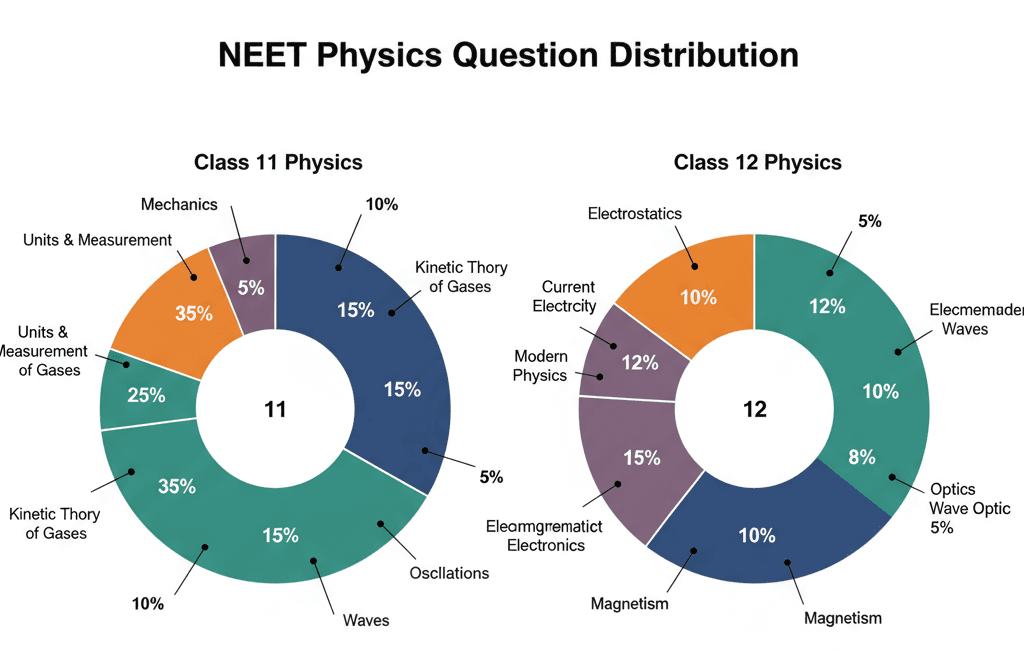
Overall Summary of Important Topics:
| Chapter | Avg. Questions/Year |
| Current Electricity | 4.2 |
| Electrostatic Potential and Capacitance | 4.0 |
| Motion of a System of Particles and Rotational Motion | 3.6 |
| Units & Measurement | 3.4 |
| Magnetic Effects & Magnetism | 3.2 |
| Semiconductors | 3.2 |
Prep ROI: Time vs Output
| Chapter | Prep Hrs | Avg. Qs/Year | ROI (Qs/Hr) |
| Current Electricity | 8 | 4.2 | 0.525 |
| Units & Measurement | 16 | 3.4 | 0.21 |
| Semiconductors | 12 | 3.2 | 0.27 |
| Waves | 8 | 0.6 | 0.075 |
MyExams Strategy Tips:
- Prioritise: Current Electricity, Rotational Motion and Modern Physics.
- Skip-heavy: Unless aiming for 650+, reduce time on Waves, SHM, Kinetic Theory and Thermodynamics.
- Concept clarity > Memorisation in Physics.
Difficulty Distribution (Physics Section)
| Year | Easy | Moderate | Tough |
| 2021 | 18 | 21 | 6 |
| 2022 | 20 | 20 | 5 |
| 2023 | 19 | 21 | 5 |
| 2024 | 22 | 19 | 4 |
| 2025 | Est. 23+ easy | <20 moderate | 2–3 tough |
Trend Insight: Physics is becoming more approachable but still demands clarity in concepts.
Part-3_Chemistry Insights: Chapter-wise Question Trends & Prep Strategy
Subject Nature: Logic-Driven, Conceptual + Memory Based
Chemistry sits between theory-heavy Biology and numerically intensive Physics. Chemistry offers a scoring opportunity if tackled smartly. The right blend of understanding and memorization makes Chemistry one of the highest scoring sections. With proper revision cycles, NCERT reading, and smart topic selection, one gets an extra edge on other subjects.
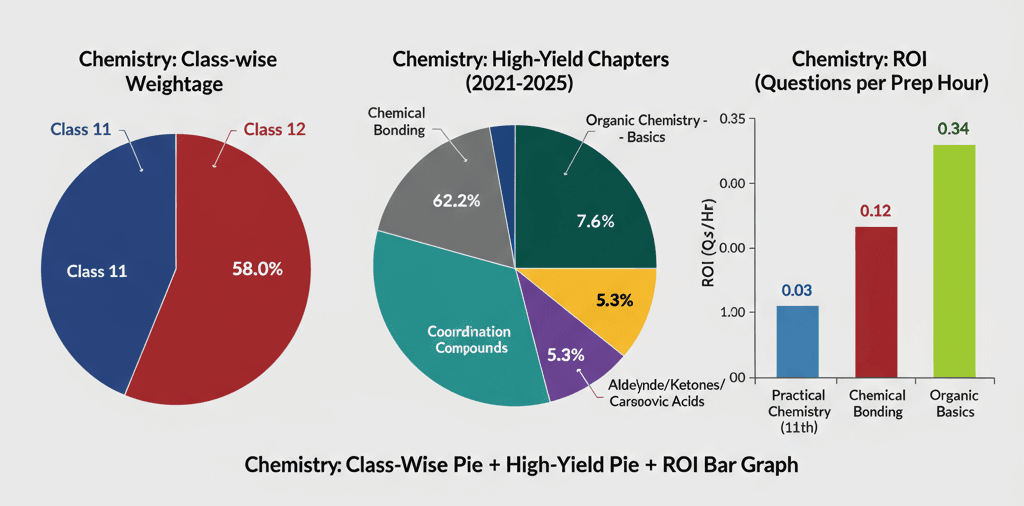
Chemistry Class-Wise Pie + High-Yield Pie + ROI Bar Graph
Class 11: Chapters to Prioritize in Chemistry
| S.No | Class | Avg. Questions per Year | Prep Hours | Revision Hours | |
| 1 | Some Basic Concepts of Chemistry | 11 | 1.6 | 8 | 4 |
| 2 | Structure of an Atom | 11 | 2.2 | 9 | 4 |
| 3 | Classification of Elements and Periodicity in Properties | 11 | 1.8 | 18 | 6 |
| 4 | Chemical Bonding and Molecular Structure | 11 | 4.0 | 34 | 15 |
| 5 | Thermodynamics | 11 | 2.2 | 12 | 6 |
| 6 | Equilibrium | 11 | 2.8 | 12 | 6 |
| 7 | Redox Reactions | 11 | 0.8 | 6 | 3 |
| 8 | Some p-Block Elements (Boron & Carbon Family) | 11 | 0.4 | 6 | 2 |
| 9 | Organic Chemistry – Basic Principles & Techniques | 11 | 3.4 | 10 | 4 |
| 10 | Hydrocarbons | 11 | 2.2 | 6 | 3 |
Class 12: Chapters to Prioritize in Chemistry
| S.No | Chapter Name | Class | Avg. Questions per Year | Prep Hours | Revision Hours |
| 1 | Solutions | 12 | 2.0 | 8 | 4 |
| 2 | Electrochemistry | 12 | 2.2 | 8 | 4 |
| 3 | Chemical Kinetics | 12 | 3.2 | 9 | 4 |
| 4 | The p-Block Elements | 12 | 2.0 | 9 | 3 |
| 5 | d and f-Block Elements | 12 | 2.4 | 6 | 2 |
| 6 | Coordination Compound | 12 | 3.2 | 21 | 8 |
| 7 | Haloalkanes and Haloarenes | 12 | 2.2 | 9 | 4 |
| 8 | Alcohols, Phenols, and Ethers | 12 | 2.0 | 10 | 5 |
| 9 | Aldehyde, Ketones, and Carboxylic Acids | 12 | 3.2 | 10 | 5 |
| 10 | Amines | 12 | 2.4 | 8 | 4 |
| 11 | Biomolecules | 12 | 1.2 | 6 | 3 |
| 12 | Principles Related to Practical Chemistry | 12 | 0.6 | 15 | 6 |
Graphical Analysis: Chemistry Question Distribution in NEET UG from Class-XI & XII
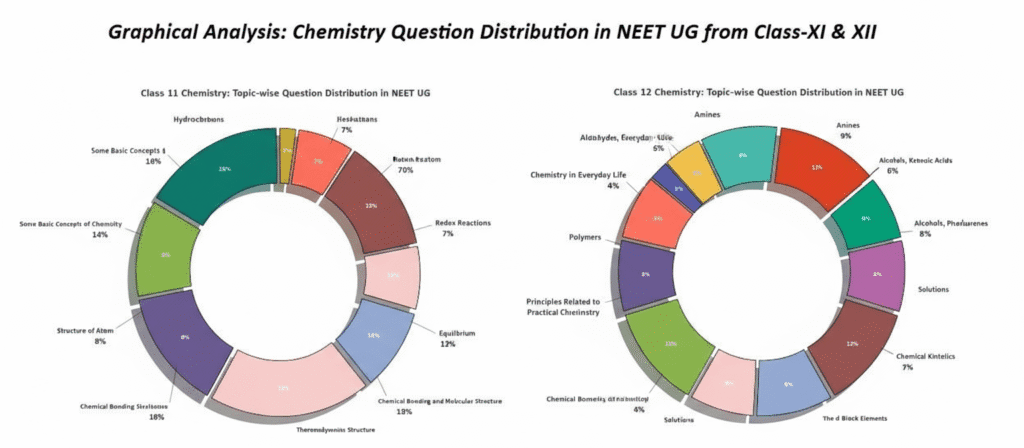
Class-Wise Weightage in Chemistry
| Class | Avg. Qs (5 Years) | Contribution |
| Class 11 | 21.4 | 42% |
| Class 12 | 29.6 | 58% |
High Weightage Topics of Class XI & XII-Biology
| Chapter Name | Avg. Qs/Year |
| Chemical Bonding & Molecular Structure | 4.0 |
| Organic Chemistry – Basics | 3.4 |
| Chemical Kinetics | 3.2 |
| Coordination Compounds | 3.2 |
| Aldehyde, Ketones, Carboxylic Acids | 3.2 |
High-Time, Low-Yield Chapters
| Chapter | Ques./Year | Prep Hrs | ROI |
| Principles Related to Practical Chemistry | 0.6 | 15 | Poor |
| Some p-Block Elements (Boron & Carbon) | 0.4 | 6 | Very Low |
Preparation Hours Estimate
| Task | Total Hrs |
| 1st Round Prep | 274 hrs |
| Revision | 112 hrs |
| Total | 386 hrs |
Part-4 Biology Insights: Chapter-wise Question Trends & Prep Strategy
Subject Nature: NCERT-Based, Memory-Oriented
Biology carries 50% of the NEET weightage. While most questions are directly NCERT-based, the trap lies in overconfidence. You must revisit diagrams, examples, and fine print regularly.
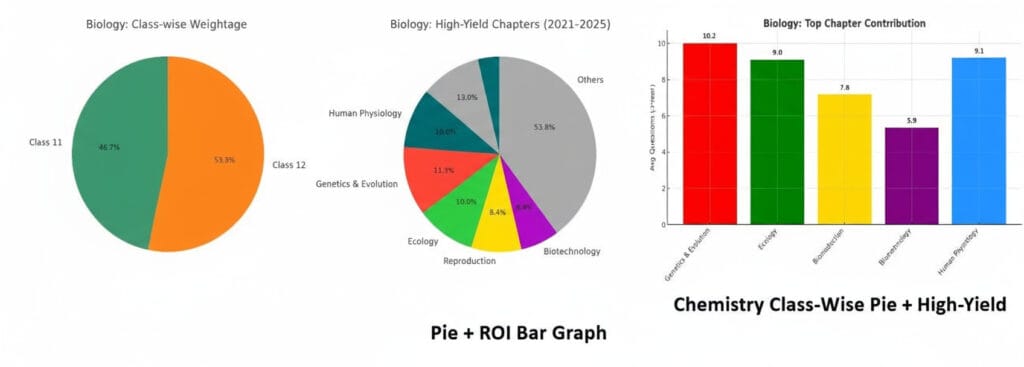
Chemistry Class-Wise Pie + High-Yield Pie + ROI Bar Graph
Class-11: Chapters to Prioritize in Biology
| S.No | Chapter Name | Class | Avg. Questions per Year | Prep Hours | Revision Hours |
| 1 | The Living World | 11 | 0.0 | 4 | 1.5 |
| 2 | Biological Classification | 11 | 1.2 | 8 | 2.5 |
| 3 | Plant Kingdom | 11 | 3.6 | 7 | 2.5 |
| 4 | Animal Kingdom | 11 | 4.6 | 8 | 2.5 |
| 5 | Morphology of Flowering Plants | 11 | 3.8 | 8 | 2.5 |
| 6 | Anatomy of Flowering Plants | 11 | 2.8 | 7 | 2.5 |
| 7 | Structural Organisation in Animals | 11 | 4.0 | 8 | 2.5 |
| 8 | Cell – The Unit of Life | 11 | 4.0 | 11 | 3.5 |
| 9 | Biomolecules | 11 | 4.8 | 9 | 2.5 |
| 10 | Cell Cycle & Cell Division | 11 | 4.4 | 7 | 2.5 |
| 11 | Photosynthesis in Higher Plants | 11 | 3.0 | 7 | 2.5 |
| 12 | Respiration In Plants | 11 | 2.2 | 6 | 2.5 |
| 13 | Plant Growth and Development | 11 | 2.8 | 6 | 2.5 |
| 14 | Breathing and Exchange of Gases | 11 | 1.6 | 9 | 2.5 |
| 15 | Body Fluids & Circulation | 11 | 2.2 | 8 | 2.5 |
| 16 | Excretory Products & Their Elimination | 11 | 1.2 | 8 | 2.5 |
| 17 | Locomotion & Movement | 11 | 2.4 | 6 | 2.5 |
| 18 | Neural Control and Coordination | 11 | 1.2 | 7 | 2.5 |
| 19 | Chemical Coordination and Integration | 11 | 2.4 | 8 | 2.5 |
Class-12: Chapters to Prioritize in Biology
| S.No | Chapter Name | Class | Avg. Questions per Year | Prep Hours | Revision Hours |
| 1 | Sexual Reproduction in Flowering Plants | 12 | 3.4 | 8 | 2.5 |
| 2 | Human Reproduction | 12 | 4.2 | 8 | 2.5 |
| 3 | Reproductive Health | 12 | 2.6 | 5 | 1.5 |
| 4 | Principles of Inheritance and Variation | 12 | 5.4 | 11 | 3.5 |
| 5 | Molecular Basis of Inheritance | 12 | 7.2 | 11 | 3.5 |
| 6 | Evolution | 12 | 3.0 | 9 | 2.5 |
| 7 | Human Health & Diseases | 12 | 3.6 | 8 | 1.5 |
| 8 | Microbes In Human Welfare | 12 | 1.8 | 5 | 2.5 |
| 9 | Biotechnology Principles & Processes | 12 | 6.4 | 7 | 2.5 |
| 10 | Biotechnology And its Applications | 12 | 3.8 | 6 | 2.5 |
| 11 | Organisms and Populations | 12 | 3.8 | 7 | 2.5 |
| 12 | Ecosystem | 12 | 2.8 | 4 | 2.5 |
| 13 | Biodiversity & Conservation | 12 | 3.2 | 6 | 2.5 |
Graphical Analysis: Biology Question Distribution in NEET UG from Class-XI & XII
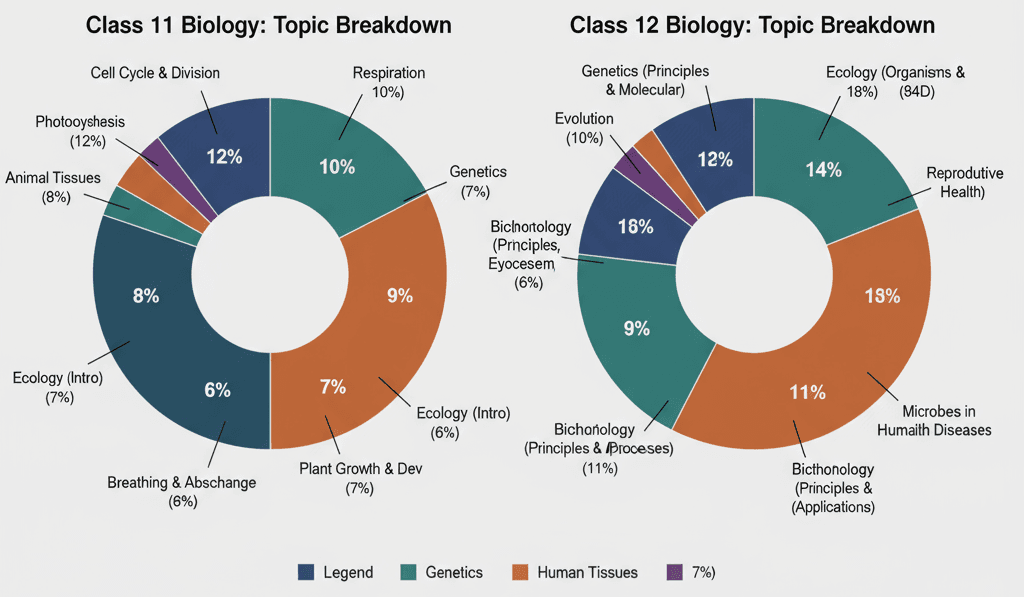
High Weightage Topics of Class XI & XII-Biology
| Chapter | Class | Avg. Qs (5Y) |
| Human Physiology | XI | 9.0 |
| Diversity of Living World | XI | 7.8 |
| Plant Physiology | XI | 6.4 |
| Genetics & Evolution | XII | 10.2 |
| Ecology | XII | 9.0 |
| Reproduction | XII | 7.6 |
Class XII Biology
| Chapter | Avg. Qs (5Y) |
| Reproduction | 7.6 |
| Genetics & Evolution | 10.2 |
| Biology in Human Welfare | 5.4 |
| Biotechnology | 5.8 |
| Ecology | 9.0 |
Smart Tips for Biology
- Focus on Human Physiology, Genetics, and Ecology contribute 35%+ of Biology paper.
- Study NCERT line by line underline and annotate.
- Practice with diagram-based MCQs and assertion-reason types.
Final Word: A Unified Study Blueprint for NEET 2025
Across all three subjects, the mantra is the same: “Don’t study everything equally. Study what counts.” Use these insights and time investment data to structure your daily study routine. Here’s a smart way to allocate time weekly:
| Subject | Study Hrs/Week | Revision Hrs |
| Biology | 22–25 hrs | 5 hrs |
| Chemistry | 14–16 hrs | 4 hrs |
| Physics | 14–16 hrs | 5 hrs |
Combined Prep Strategy
- Prioritize Class 12 chapters first.
- Use this data to build a 90-day chapter planner.
- Stick to NCERT + PYQs + regular mock analysis.
FAQ’s
1. Is it true that the Class 12 syllabus carries more weightage in NEET?
Ans: Yes, there is a slight tilt. Recent trends show that Class 12 topics hold the upper hand, especially in Physics and Chemistry. However, ignoring or giving less attention to Class 11 is a wrong strategy. You simply cannot build a strong score without the foundation of Class 11, and in Biology specifically, units like Human Physiology are absolute giants that you cannot afford to miss.
2. Physics is my weakest subject. Which chapters should I prioritize to pass the cutoff?
Ans: Stop trying to cover the whole syllabus if you are struggling. Focus your energy on the high weightage chapters. Topics like ‘Current Electricity’ & ‘Electrostatics’ are consistent high-scorers in the exam. Even though the chapter “Rotational Motion’’ is tough, it asks so many questions that it’s worth the effort. If you are running out of time, you can go light on a few topics like Waves, but make sure your high-weightage concepts are good.
3. Is reading NCERT enough for the Biology section?
Ans: For 90% of the paper, the answer is yes. But passive reading won’t cut it. You need to practically memorize the lines, especially for “Genetics’’ and ‘‘Ecology”, which our data shows are the high weightage units. Don’t just read the text; obsess over the diagrams and the captions below them. NEET often pulls tricky questions from that data.
4. How should I divide my study time between the three subjects?
Ans: Don’t split your time equally among the three subjects. Biology is half the paper, so treat it that way. We recommend dedicating about 22–25 hours a week to Biology. Physics and Chemistry are harder but carry fewer marks individually, so 15 hours each (may vary for a few students) is a clearer strategy. Use this balance to ensure you are maximizing your total score, rather than just mastering one tough subject.
5. What is the smartest way to tackle NEET Chemistry?
Ans: You have to switch gears depending on the chapter. Physical Chemistry needs formula practice, just like Physics. But for Inorganic, stick to the NCERT like it is Biology. Our analysis highlights “Chemical Bonding’’ and ‘Coordination Compounds’ as the top ROI chapters. If you master just these two, you have already secured a significant portion of the Chemistry section of NEET.